


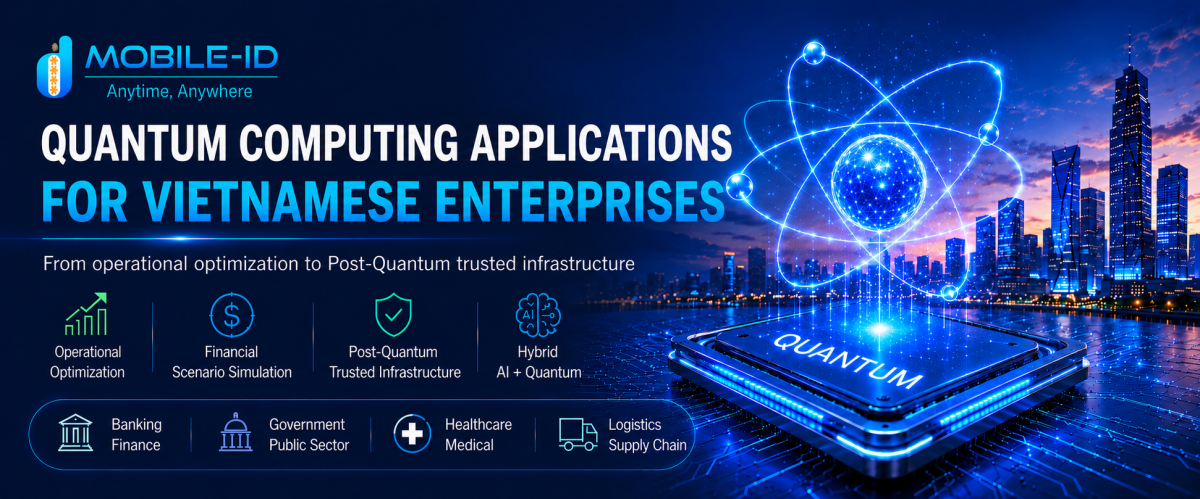
Mobile-ID and the Wave of Quantum Applications: from quantum research to practical operational value
While research laboratories worldwide continue expanding quantum computing capabilities, Mobile-ID pursues a more pragmatic direction: building an enterprise application layer integrating orchestration, digital trust, audit trails, and decision-support — enabling organizations to experiment with and measure quantum value today, without waiting for perfect hardware.
Quantum computing is no longer science fiction. But for enterprises, the real question isn’t “who builds the most powerful QPU?” but rather “which applications can transform quantum, AI, and cloud infrastructure capabilities into better, faster, and verifiable business decisions?”
1. From Sycamore to Zuchongzhi: Signals of a New Technology Cycle
In 2019, Google unveiled the Sycamore 53-qubit quantum processor capable of solving a sampling problem in approximately 200 seconds — a significant milestone in “quantum computational advantage” that classical supercomputers would require thousands of years to match according to initial estimates. Since then, research groups in the US, China, and many other countries have continuously announced advances in qubit count, fidelity, error reduction, and cloud accessibility.
In China, systems like Jiuzhang (photonic quantum computing) and Zuchongzhi (superconducting quantum processor) continue expanding the quantum computing capability race. Zuchongzhi-3, introduced in 2025, is a 105-qubit superconducting quantum processor with 182 couplers — demonstrating the rapid pace of quantum ecosystem development in Asia.
2. Mobile-ID Chooses the Right Position in the Quantum Value Chain
Mobile-ID’s positioning in quantum is crystal clear: Mobile-ID does not define itself as a quantum hardware manufacturer. Instead, the company focuses on building hybrid classical + AI + quantum workflows, deployed on Google Cloud, integrating governance, trust, audit, and compliance layers appropriate for enterprises, banks, finance, and public sector.
This strategic positioning has high commercial value because the market doesn’t buy “quantum” as an abstract concept. The market buys measurable results: reduced operational costs, optimized schedules, faster processing, efficient resource allocation, more accurate risk assessment, and auditable evidence for every critical decision.
Trusted Quantum Optimizer
Optimize routing, dispatch, scheduling, resource allocation, and complex operational workflows with multiple policy and business constraints.
Trusted Quantum Finance Sandbox
Safe testing environment for treasury management, liquidity planning, fraud detection, AML scoring, risk clustering, and portfolio optimization.
Trusted Quantum Studio
Orchestration layer connecting enterprise data with classical solvers, hybrid solvers, and quantum backends — enabling teams to rapidly deploy PoCs and measure ROI clearly.
Trusted Quantum Readiness
Workshop exploring use cases, assessing business value, designing PoCs, benchmarking baselines, and training internal teams ready to embrace quantum.
3. Why Mobile-ID Has the Right Foundation to Lead Enterprise Quantum Applications
Mobile-ID’s core strengths lie in digital identity, PKI, digital signatures, trust services, secure workflows, and system integration for heavily regulated sectors. These are precisely the capabilities that directly support quantum applications in enterprises — because quantum solver results only gain real value when embedded in controlled processes with clear authorization, approval mechanisms, complete audit trails, and regulatory accountability.
| Mobile-ID Core Capability | Role in Quantum Applications | Customer Value Created |
|---|---|---|
| Digital identity & access control | Control who creates, runs, approves, and views optimization scenario results — ensuring proper authorization for every action. | Reduces operational risk, meets authorization requirements, protects sensitive data. |
| PKI, trust services & secure signing | Digitally sign problem configurations, optimization results, reports, event logs, and decision evidence — ensuring output data integrity. | Increases integrity, prevents repudiation, supports internal and external audit. |
| Enterprise system integration | Seamlessly connect with ERP, core banking, operational dashboards, workflow APIs, and existing data pipelines. | Helps PoCs progress beyond demos to real production deployment. |
| Regulated-sector delivery experience | Design human-in-the-loop approvals, complete audit trails, policy constraints, and compliance reporting for regulated industries. | Aligns with unique requirements of banking, government, healthcare, logistics, and critical infrastructure. |
4. Market Acceptance Potential: Starting with “Quantum-Inspired Value” Before “Full Quantum Advantage”
The quantum application market won’t explode through single large-scale transformation. This process will likely unfold through three sequential adoption layers: first, readiness consulting and PoC projects; second, optimization problems using classical or quantum-inspired solvers; and finally, hybrid workloads leveraging quantum backends as hardware matures and costs become reasonable.
With its current positioning, Mobile-ID can generate revenue across the first two layers without waiting for quantum computers to mature. This significantly reduces commercial risk while helping customers understand quantum value through specific operational problems — rather than complex technical terminology.
Market segments with earliest quantum adoption potential
- Banking and finance: prioritize AML/fraud case prioritization, liquidity scenario modeling, ATM cash replenishment optimization, portfolio approximation, and risk clustering with high combinatorial complexity.
- Government and public sector: inspection scheduling coordination, multi-unit resource allocation, administrative file balancing, government vehicle routing optimization, and field team scheduling.
- Large-scale operations enterprises: workforce scheduling, field technician routing, dispatch optimization, service allocation, and bulk approval workflow processing in real-time.
- Healthcare and critical infrastructure: medical equipment scheduling optimization, hospital resource allocation, patient care coordination, transportation routing, and flexible response capability during disruptions.
5. Quantum and Post-Quantum Cryptography: Two Implementation Directions Must Progress Simultaneously
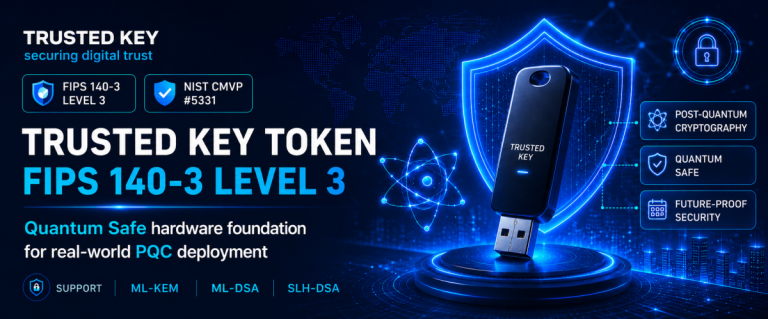
As quantum computing capabilities increase, the market faces not just optimization applications but also cryptographic security challenges. NIST has officially approved post-quantum cryptography (PQC) standards including FIPS 203 (ML-KEM for key establishment), FIPS 204 (ML-DSA for digital signatures), and FIPS 205 (SLH-DSA for stateless hash-based signatures). This is particularly relevant for companies with PKI, digital signature, and trust service foundations like Mobile-ID.
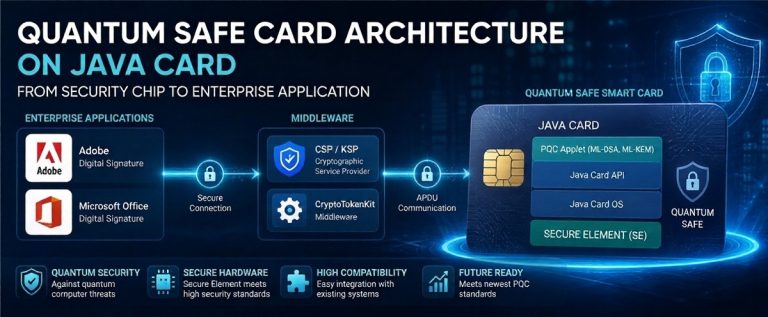
Experience from international digital trust providers like Ascertia shows that PQC migration is not merely algorithm replacement. It requires integrating new algorithms into real-world infrastructure: X.509 certificates, CMS signatures, OCSP responses, CRLs, and timestamp tokens. This is a capability area where Mobile-ID can proactively prepare to extend the Quantum story from “optimization applications” to “post-quantum-safe trusted infrastructure”.
6. Proposed Implementation Roadmap: Pragmatic, Verifiable, Easy to Commercialize
Key Points to Remember
- Quantum computing delivers real application value today for complex combinatorial problems — hardware maturity is not a prerequisite.
- Mobile-ID’s positioning as application and orchestration layer provider, not hardware manufacturer, is correct strategy with sustainable competitive advantage.
- Mobile-ID’s PKI, digital trust, and audit trail capabilities are irreplaceable competitive advantages in enterprise quantum applications.
- Post-Quantum Cryptography is the next growth area that Mobile-ID must prepare alongside optimization applications.
- Finance, government, and logistics sectors show clearest needs and earliest adoption potential in Vietnam and Southeast Asia markets.
7. Conclusion: Opportunity Lies Not in “Talking About Quantum” But in Making Quantum Real Workflows
Mobile-ID is pursuing a commercially sound and sustainable direction: standing as intermediary between enterprises and the global quantum ecosystem, transforming business problems into runnable optimization models, converting models into controlled workflows with clear authorization, and converting results into trustworthy audit evidence.
By maintaining this pragmatic approach, Mobile-ID can establish regional leadership in Southeast Asia: not by competing with Google, IBM, or research institutions on hardware, but by becoming the trusted enterprise quantum application provider for organizations needing better decisions in operationally constrained, high-risk, strictly regulated environments.
Frequently Asked Questions About Enterprise Quantum Applications
What is Mobile-ID Quantum and which business types does it serve?
Mobile-ID Quantum is an enterprise quantum computing application platform focused on hybrid classical + AI + quantum workflows deployed on Google Cloud. It serves financial institutions, banks, governments, logistics companies, and healthcare organizations — especially those with complex optimization problems, strict audit requirements, and current system integration needs.
What conditions must enterprises meet to begin quantum applications?
Enterprises need: operational problems with high error costs (e.g., routing, scheduling, risk scoring), sufficient data quality for modeling, and readiness for short-term PoCs (typically 4–8 weeks). Mobile-ID supports the entire journey from Quantum Readiness Workshop through pilot design and ROI measurement.
What is Post-Quantum Cryptography (PQC) and why does it matter for enterprises?
Post-Quantum Cryptography (PQC) comprises new cryptographic algorithms designed to resist attacks from powerful future quantum computers. NIST has approved standards FIPS 203 (ML-KEM), FIPS 204 (ML-DSA), and FIPS 205 (SLH-DSA). Enterprises using PKI, digital signatures, and digital certificates should begin PQC transition planning immediately to ensure long-term security.
How does quantum-inspired optimization differ from true quantum computing?
Quantum-inspired optimization uses algorithms inspired by quantum mechanics (such as simulated annealing, tensor networks) running on classical hardware to solve complex combinatorial problems. True quantum computing uses qubits and quantum mechanics directly. Short-term, quantum-inspired solvers often deliver greater practical value because they don’t depend on expensive, unstable quantum hardware.
Why are PKI and digital trust capabilities important in enterprise quantum applications?
In enterprise and public sector settings, quantum solver results only gain legal and operational value when embedded in controlled processes: clear access control, multi-level approval, complete action logs, and cryptographically signed results to prevent repudiation. This is exactly where Mobile-ID’s PKI and digital trust capabilities create decisive advantage over purely technical quantum providers.
- Mobile-ID Quantum — Enterprise Quantum Computing Application Platform: https://quantum.mobile-id.vn/en
- Google / Nature, “Quantum supremacy using a programmable superconducting processor” (2019): https://www.nature.com/articles/s41586-019-1666-5
- Chinese Academy of Sciences, Zuchongzhi-3 superconducting quantum processor announcement (2025): https://english.cas.cn/head/202503/t20250305_903086.shtml
- NIST, Post-Quantum Cryptography Standards FIPS 203, 204, 205 (2024): https://csrc.nist.gov/News/2024/postquantum-cryptography-fips-approved
- Ascertia Blog, “Implementing PKI & Digital Signatures using PQC in ADSS Server”: https://blog.ascertia.com/implementing-pki-digital-signatures-using-pqc-in-adss-server


Community Discussion