


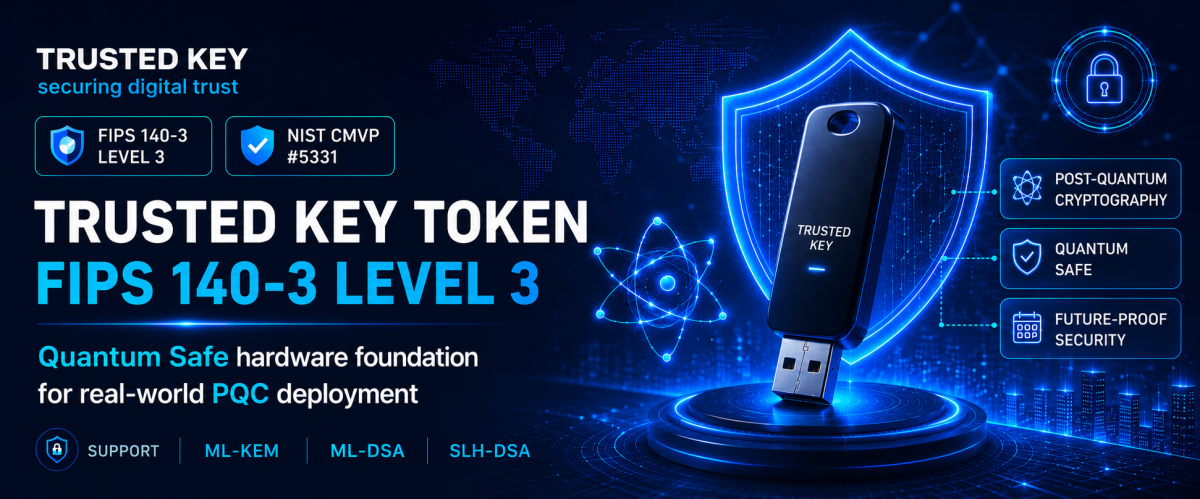
Trusted Key Token FIPS 140-3 Level 3: the first Quantum Safe hardware foundation for real-world PQC
Mobile-ID’s Trusted Key Token Cryptographic Module is positioned as one of the first Quantum Safe devices to achieve FIPS 140-3 Level 3 certification. This milestone is not just a hardware certification achievement — it is the critical foundation that moves post-quantum cryptography (PQC) from standards and lab trials into real-world deployment across enterprises, governments, and the digital trust services ecosystem.
Today’s cryptographic infrastructure faces quantum risk: why organizations must act now
Enterprises, governments, and trust service providers are entering a critical transition, where RSA- and ECC-based infrastructure must be prepared for a future in which quantum computers could break traditional public-key cryptography. The question is not only which algorithm to choose, but how to deploy post-quantum cryptography (PQC) inside hardware, identity systems, digital signing workflows, and compliance frameworks.
From NIST PQC standards to internationally certified hardware products
The publication of NIST’s core post-quantum cryptography standards has shifted the market conversation. ML-KEM, ML-DSA, and SLH-DSA have become reference points for long-term migration roadmaps. However, the market only moves when PQC is packaged in devices, workflows, and certifications that customers can verify. Trusted Key therefore acts as a bridge: translating PQC direction into an internationally certified hardware platform that is integrable and operable in real environments.
Why hardware cryptographic tokens are the right choice for high-assurance digital signatures
For high-assurance digital signatures, private keys must be protected by design. A portable cryptographic token delivers the trusted model enterprises know: keys are generated, stored, and used inside the secure device, while host applications interact through middleware rather than directly handling cryptographic secrets.
The market will not adopt Quantum Safe simply because the technology exists in a lab or in a standards document. The market will adopt it when the technology is embedded in certified hardware, integrated with existing signing applications, and operated under the compliance model that security teams already trust.
NIST CMVP Certificate #5331: Trusted Key Token achieves FIPS 140-3 Level 3 with PQC support
Trusted Key Token Cryptographic Module is positioned as one of the first Quantum Safe devices to achieve FIPS 140-3 Level 3 on the market. The significance lies not only in the PQC capability it supports, but in the fact that this capability is built on a hardware cryptographic module with internationally recognized certification. This is the foundation that allows customers, integration partners, trust service providers, and regulators to view PQC as a deployment roadmap with a verifiable basis — not a technology still far from practice.
Why international certification builds genuine confidence
FIPS 140-3 certification demonstrates that a cryptographic module has been independently evaluated against internationally recognized security standards. For Trusted Key, the NIST CMVP record identifies it as an Active hardware cryptographic module with an overall assurance level of Level 3. For customers, this is third-party evidence that reduces procurement risk. For the PQC ecosystem, it provides an anchor point on which integration partners can build products, services, and post-quantum migration workflows on a trustworthy foundation.
- Hardware-based cryptographic module
- Secure portable device using smart card technology
- Designed for authentication, digital identity, digital signing, and sensitive data protection
- A trust foundation for enterprises, government agencies, and PQC ecosystem partners
Quantum Safe becomes viable when a certified device exists
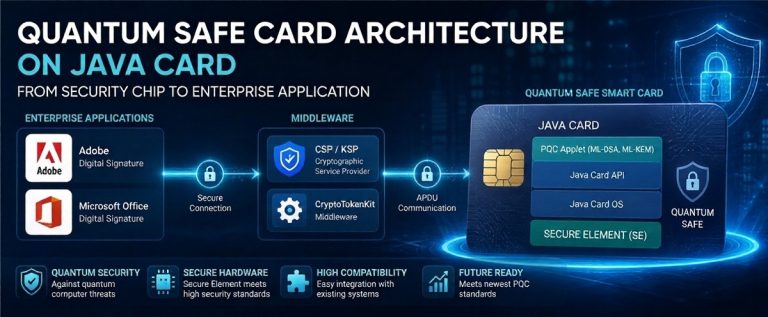
Mobile-ID’s Quantum Safe model extends the trust foundation beyond traditional cryptography. Rather than treating PQC as a standalone algorithm experiment, this architecture places post-quantum capability within a complete product chain: secure chip, JavaCOS, PQC applet, APDU command model, middleware, and enterprise application. This gives PQC a clear path into real-world use cases — digital signing, strong authentication, digital identity, and long-term data protection.
- Post-quantum digital signing pathway aligned with ML-DSA
- Key establishment roadmap aligned with ML-KEM
- Applet-layer orchestration that makes PQC an integrable product capability
- Desktop and trust service integration paths for real-world signing workflows
Five-layer architecture: from Secure Controller to PQC enterprise application
A Quantum Safe token only becomes commercially meaningful when every layer is designed as a unified operational chain. Mobile-ID’s architecture follows a layered model that separates secure hardware capability, card OS services, PQC applet logic, middleware abstraction, and enterprise applications. This approach ensures that FIPS 140-3 Level 3 certification does not stand alone as a “compliance badge,” but becomes the foundation for a PQC ecosystem that can be deployed, tested, integrated, and scaled.
Secure Controller
Provides tamper-resistant hardware, secure key storage, and low-level cryptographic capability required for a high-assurance token.
JavaCOS / Card OS
Manages applet lifecycle and provides the cryptographic functions or APIs required by the PQC application layer.
PQC Applet
Orchestrates key objects, usage policies, algorithm profiles, APDU commands, and signing flows while keeping the private key inside the device.
Desktop Middleware
Bridges the token to Windows CSP/KSP, macOS CryptoTokenKit, and PC/SC readers, shielding business applications from APDU complexity.
Business Application
Enables signing workflows in Adobe Acrobat, Microsoft Office, internal enterprise systems, and trust service platforms.
The breakthrough is not just bringing PQC onto a card — it is bringing PQC onto an internationally certified device. The breakthrough is creating a complete operational model where PQC can be used by real applications, real users, and real regulated organizations.
Why this is more than a cryptographic upgrade
Moving from traditional OpenPGP-style smart card logic to PQC is not simply a matter of adding a new algorithm identifier. Post-quantum keys, signatures, and command flows are larger, have different lifecycle rules, and require new middleware.
Designing to the right technical boundary
A PQC applet should not attempt to re-implement the entire post-quantum algorithm stack in resource-constrained Java Card code if the card OS already provides native cryptographic support. A stronger design lets the applet act as an orchestration layer: managing key slots, enforcing policy, sequencing commands, and calling the cryptographic functions already available from the secure card platform.
Built for the realities of APDU, memory, and process
PQC produces larger public keys, signatures, and intermediate data. Therefore, Trusted Key’s Quantum Safe design must carefully handle chunked APDU transmission, memory allocation, key metadata, algorithm profiles, and session state. These are exactly the details that prevent many proof-of-concept builds from becoming deployable products.
International certification is the prerequisite for PQC to enter the market
For customers, PQC is not just a story about new algorithms. It is an investment decision in an infrastructure layer that affects digital signatures, authentication, identity, key storage, and legal evidence for years to come. This is why a Quantum Safe device achieving FIPS 140-3 Level 3 functions as a “trust anchor” that allows all parties in the ecosystem to begin deployment together.
Reducing customer risk during the transition
International certification gives customers an additional basis for evaluation beyond relying solely on vendor claims. For organizations with rigorous approval processes, FIPS 140-3 Level 3 supports information security assessment, audit, vendor risk management, and phased PQC migration planning.
Creating an anchor point for integration partners
Once the underlying hardware is certified, integrators, digital signing application developers, trust service providers, and certificate authorities can focus on user experience, business workflows, certificate policy, and deployment models. This is how a new technology like PQC can form an ecosystem rather than remaining only a standalone technical capability.
The critical foundation for real-world PQC deployment
The digital trust market is shifting from “current cryptographic compliance” toward “resilience against future cryptographic risk.” Trusted Key gives Mobile-ID a credible position in that transition: a hardware trust anchor that is certified today, with an architecture capable of supporting Quantum Safe migration. This is the essential prerequisite for PQC to be deployed in a controlled, evidence-based, integrable manner — with sufficient assurance for customers.
Customers need verifiable trust
The public sector, banking, healthcare, energy, and telecommunications do not just need digital signing or strong authentication tools; they need evidence that the device has been evaluated against an internationally recognized standard. FIPS 140-3 Level 3 makes the selection and approval process more defensible before information security boards, audit teams, and regulators.
PQC ecosystem partners
Certificate authorities, remote signing platforms, digital identity providers, system integrators, and application developers can view Trusted Key as a reliable anchor point for building PQC services. With the underlying device holding international certification, the ecosystem has a stronger basis for experimentation, integration, commercialization, and scaling.
Real-world deployment in existing workflows
Through middleware integration paths such as Windows CSP/KSP and macOS CryptoTokenKit, the token can be introduced into existing document signing workflows without forcing users to switch to entirely new applications. This is the key factor that moves PQC beyond technical trials and into daily operations.
Long-term trust for data and transactions
Contracts, identity assertions, managed records, and high-value digital signatures may need to maintain trustworthiness for many years. A Quantum Safe device achieving FIPS 140-3 Level 3 creates the foundation for customers to protect long-term data and transactions against post-quantum cryptographic risk.
Key Takeaways
- Trusted Key Token is among the world’s first Quantum Safe devices to achieve FIPS 140-3 Level 3 (NIST CMVP Certificate #5331), certified as Hardware — MultiChipEmbed.
- The device supports ML-KEM, ML-DSA, and SLH-DSA — the three core PQC standards published by NIST (FIPS 203/204/205).
- A five-layer architecture — Secure Controller → JavaCOS → PQC Applet → Desktop Middleware → Business Application — ensures PQC can integrate into existing signing workflows (Adobe Acrobat, Microsoft Office, Windows CSP/KSP, macOS CryptoTokenKit).
- International certification helps enterprises, government agencies, and trust service providers reduce risk when selecting PQC infrastructure, rather than relying solely on vendor assurances.
- This is a hardware trust anchor that enables the PQC ecosystem — CA organizations, remote signing platforms, integrators — to build products and Quantum Safe migration roadmaps on a verifiable foundation.
Trusted Key: the internationally certified Quantum Safe device for the PQC ecosystem
With FIPS 140-3 Level 3 certification and a layered PQC architecture, Trusted Key gives Mobile-ID a clear market message: PQC can be deployed on certified hardware, integrated into existing workflows, and trusted by customers. This is the essential foundation for forming a real Quantum Safe ecosystem — where standards, devices, software, trust services, and customers all operate on a verifiable security base.
Trusted Key Token and FIPS 140-3 PQC — Quick Answers
What is Trusted Key Token and what certification does it hold?
Trusted Key Token Cryptographic Module is a portable hardware cryptographic device from Mobile-ID JSC. The device holds FIPS 140-3 Level 3 certification (NIST CMVP Certificate #5331, dated 06/16/2026), classified as Hardware — MultiChipEmbed with Active status. It is among the first Quantum Safe devices to achieve this level of assurance on the market.
Which PQC algorithms does Trusted Key Token support?
Trusted Key Token is designed to support the core PQC standards published by NIST: ML-DSA (FIPS 204) for post-quantum digital signatures, ML-KEM (FIPS 203) for key establishment, and SLH-DSA (FIPS 205) as an additional option. These algorithms are orchestrated through the PQC Applet layer within the device’s Java Card architecture.
Can Trusted Key Token integrate into existing digital signing workflows?
Yes. Trusted Key Token connects to Windows CSP/KSP, macOS CryptoTokenKit, and PC/SC readers through the Desktop Middleware layer. This enables integration with applications such as Adobe Acrobat, Microsoft Office, and internal signing systems without requiring changes to existing business workflows.
How does FIPS 140-3 Level 3 differ from Level 2?
FIPS 140-3 Level 3 requires the device to have stronger physical tamper-resistance and tamper-evidence mechanisms than Level 2. At Level 3, protective measures must make secret keys inaccessible when the device is compromised. This is the assurance level typically required for government, banking, and trust service infrastructure applications.
Which industries are suited for Trusted Key Token deployment?
Trusted Key Token is suited for organizations requiring high-assurance digital signatures and Quantum Safe migration roadmaps, including: public sector and government agencies, banking and financial services, healthcare, energy, and telecommunications. The device is also the right choice for certificate authorities (CAs), trust service providers, and PKI system integrators.
Community Discussion