


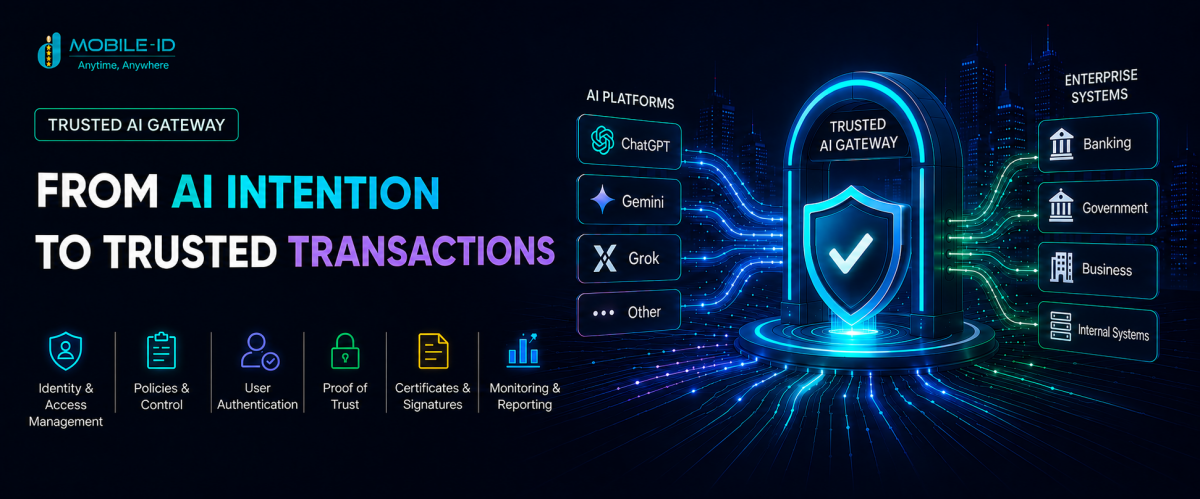
Trusted AI Gateway
Lets users tap into Mobile-ID’s trusted services directly from ChatGPT, Gemini, Grok, and other AI platforms. The experience becomes more natural, while identity, authority, delegation, policy, risk level, and evidence stay within enterprise control.
Technical positioning AI-Agnostic Trust & Transaction Control Plane
More convenient
Users express their goal in the AI platform they already use, instead of learning and switching between multiple business portals.
Control in the right place
Identity, authority, purpose, policy, and assurance level are evaluated independently before any material business impact.
Provable
Transaction context, decisions, execution results, receipts, timestamps, and audit logs are linked into a chain of evidence.
What is Trusted AI Gateway?
Mobile-ID’s Trusted AI Gateway is the trust and orchestration control layer between AI Intent and Trusted Transaction. The Gateway never treats the AI model as a source of authority: it independently verifies user identity, AI Agent Identity, authority, delegation, purpose of use, policy, risk level, and user confirmation conditions before any trusted service executes. As a result, ChatGPT, Gemini, Grok, Claude, Copilot, Enterprise AI, Private AI, or Domain Agents can become a convenient interaction point, while the Trust Boundary, source systems, evidence, and audit logs remain under enterprise control.
Choose the reading track that fits you
One article, two tracks: architectural depth or experience & commercial value.
Technical track
Multi-AI, control plane, identity/authority, policy at execution time, threat model, evidence, and deployment boundaries.
PRODUCT / BUSINESS / SALESExperience & commercial track
Before/After, conversational journeys, risk-based confirmation, multi-service orchestration, SWOT, commercial model, and PoC.
AI can understand intent. Trusted AI Gateway decides which transactions are allowed to happen.
Trusted AI Gateway is positioned as a trusted transaction control layer between AI/Agents and systems with real business impact. The AI model can understand natural language, propose parameters, pick tools, or plan a workflow; but the Gateway independently verifies identity, authority, delegation, policy, and risk, and requires evidence before a trusted service or the enterprise backend system executes.
Understands intent & proposes a plan
Natural-language intent is normalized into structured actions, objects, and parameters.
Controls trust & authority
Identity, AI agent identity, authority, delegation, purpose, policy, and risk are evaluated at the execution boundary.
Trusted systems execute
The real action happens at trusted services or source systems — never inside the model context.
Verifiable outcomes
Decisions, confirmations, execution results, receipts, timestamps, and provenance are linked into one chain of evidence.
TRUSTED AI GATEWAY CONTROLS THE TRANSACTION.Protocol connectivity is only the starting point — a trusted transaction still needs identity, authority, policy, execution control, and evidence.
AI can propose an action, but execution authority must always be re-verified by Trusted AI Gateway.
One conversational touchpoint makes work more convenient for users — without automatically handing AI transaction authority.
Instead of forcing users to remember every portal, menu, form, and process for each system, Trusted AI Gateway lets them start from a natural goal. The Gateway only asks for more data, step-up authentication, or confirmation when risk level and policy genuinely require it.
From a natural request to a trusted outcome
One example showing how AI cuts down on manual steps, while the Gateway still controls authority and risk before any business impact occurs.
Policy allows → Execute
No extra confirmation step when policy already allows it and the assurance level is sufficient.
Step-up authentication
Requires additional authentication or context-based confirmation.
Explicit user confirmation
Clearly shows the object, impact, scope, and conditions before execution.
Policy denies → Block
No call to the backend system; the denial decision and reason are stored as evidence.
Convenience does not mean giving up control: the system only asks for more authentication or confirmation when risk/policy genuinely requires it.
From many disconnected business portals to a single intent — while keeping the enterprise trust boundary intact.
Trusted AI Gateway does not replace every business portal. It adds one more experience channel for completing journeys that can be safely orchestrated by policy and trusted services.
BEFORE TRUSTED AI GATEWAY
WITH TRUSTED AI GATEWAY
AI channels can change. Trust control and the transaction contract must stay stable.
Trusted AI Gateway uses an adapter/connector layer to adapt to each AI ecosystem, while business authority, policy, execution boundaries, and the evidence model stay standardized behind it. The integration patterns below were verified against official documentation on 08/24/2026; actual capability depends on the API and enterprise configuration at deployment time.
ChatGPT / OpenAI
Integration target; the Gateway keeps authority and execution control outside the model.
Gemini / Google AI
A2A applies to agent-to-agent interoperability where the connection model fits.
Grok / xAI
Tool calls are bound by a technical contract and policy enforced at the Gateway.
Claude / Anthropic
Connectors pass only the context required for the stated purpose and scope.
Microsoft Copilot
Enterprise integration is kept separate from the source of transaction authority.
Enterprise AI
Fits AI platforms the organization manages or deploys itself.
Private AI
Keeps AI and trust infrastructure inside a chosen data zone.
Domain Agents
Domain-specific agents are only granted tools and scope under the least-privilege principle.
One conversational touchpoint
Trusted AI Gateway
Many trusted capabilities
The AI platform can change; the transaction contract, authority, policy, and evidence must stay stable on the enterprise side.
Not every AI Gateway can control a trusted transaction.
The table below describes capabilities that are typically present / not provided by default at each gateway layer. Actual capability depends on the specific product. Trusted AI Gateway focuses on the gap between “can connect” and “is authorized to transact”.
| Capability | API Gateway | LLM Gateway | MCP / Tool Gateway | Trusted AI Gateway |
|---|---|---|---|---|
| API routing | Usually ✓ | Sometimes | Tool-focused | ✓ |
| Model routing | Not by default | Usually ✓ | Not by default | AI-agnostic |
| Tool discovery / calling | Not by default | Sometimes | Usually ✓ | ✓ via connectors |
| User + AI agent identity | Usually external | Usually external | Usually external | Core control |
| Authority / Delegation / Permissions | Not by default | Not by default | Not by default | Core control |
| Consent / Purpose | External policy | May be governed | Tool scope | Transaction context |
| Business policy at execution | API policy | Model/usage policy | Tool controls | Business + trust policy |
| Step-up authentication / risk-based confirmation | Not by default | Not by default | Can be built | Built in by design |
| Trusted execution | Request routing | Routing / response generation | Tool invocation | Bound to authority + policy |
| Evidence chain | Logs | Logs / trace | Tool logs | Decision → receipt → provenance |
| Multi-service transactions | Via API | Via orchestration | Via tools | Governed orchestration |
Being able to call a tool does not mean having the authority to complete the transaction.
INTENT → IDENTIFY → ESTABLISH AUTHORITY → POLICY → CONFIRM → EXECUTE → PROVE
Every control gate produces a structured output the next step can check, so the entire transaction path can be audited or reconstructed from evidence without depending on prompt history.
Trusted transaction context
Every step produces a structured output the next step can check, so the whole transaction can be proven again later.
AI plans; the control plane verifies, binds, orchestrates, and records.
The control plane never treats model output as business truth. Every action must be bound to a subject, an agent, authority, the transaction object, purpose, a policy version, and execution evidence.
Identity
User/organization identity, authentication, and tenant context.
AI agent identity
A distinct identity for the agent, workload, or service; the AI agent is never conflated with the user.
Authority
Role · Mandate · Delegation · Scope · acting-on-behalf-of relationship.
Consent & Purpose
Consent and purpose of use, when the use case requires it.
Policy decision
Rules · constraints · allow/step-up/deny, tied to a policy version.
Risk & assurance
Risk context, assurance level, and the conditions that trigger step-up authentication.
Human-in-control
Requires explicit confirmation whenever impact, risk, or policy calls for it.
Transaction context
Object · action · amount · recipient · purpose · scope.
Orchestration
Discover · route · coordinate · execute through a strongly-typed service contract.
Evidence
Audit log · provenance · correlation · receipt · timestamp reference.
TRUSTED SERVICE ORCHESTRATOR
The AI model is not the source of authority; the control plane is where the transaction is verified and bound.
Cleanly separate the AI boundary, the trust boundary, the execution boundary, and the evidence boundary.
The goal is not to “trust the AI model more,” but to reduce the implicit power the model holds. Secrets, private keys, and source-system authority should never sit inside the model context; every tool call must pass through policy and server-side validation.
Tool isolation + policy checks. Evidence: policy decision log.
Allow-lists + least privilege. Evidence: tool-call record.
AI agent identity is scope-limited. Evidence: authority assessment.
Binds subject / actor together. Evidence: context linkage.
Nonce · idempotency · timestamp. Evidence: transaction record.
Schema + server-side validation. Evidence: request/context digest.
Step-up authentication + scoped tokens. Evidence: authentication event.
Data minimization + DLP. Evidence: access trail.
Controlled connectors / channels. Evidence: channel identity.
Tenant isolation + scoped data plane. Evidence: tenant-tagged audit log.
Reducing the implicit power of the model matters more than trying to “trust” the model more.
One intent can orchestrate several trusted services — while authority and evidence are managed as a single, unified transaction path.
The advantage of Trusted AI Gateway is not building another chatbot. The value lies in bringing the existing trusted capabilities of Mobile-ID into the AI experience through the same control plane and evidence model.
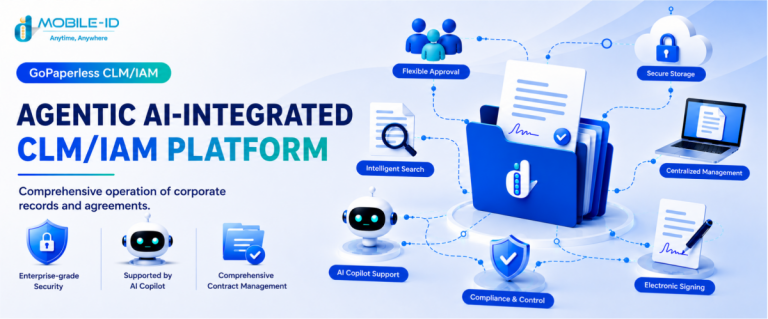
DOCUMENTS & AGREEMENTS
Documents · workflow · approval · e-signing
PAYMENTS & COMMERCE
Trusted payment execution
Invoice · verification · reconciliation
Biometrics · authentication · payment
TRUSTED DATA & DELIVERY
Send/receive · confirmation · delivery evidence
Lookup · verification · information control
Thing identity · DPP · provenance · traceability
DIGITAL EXPERIENCE & DIGITAL TRUST
Healthcare trust · purpose-driven action
Kiosk · terminal · assisted experience
Biometric identity · trust signals
Trusted timestamping · time evidence
Intent → Service map
The commercial advantage comes from letting one intent orchestrate multiple existing Mobile-ID trusted services.
Customers are not buying a “tool call”; they are buying a controlled, completed journey.
Each journey below shows how AI reduces friction at the interaction layer, while Trusted AI Gateway and the trusted services still maintain identity, authority, policy, state transitions, and evidence on the backend.
Contract-to-Sign
Invoice-to-Pay
Care-to-Action
Product-to-Trust
Message-to-Proof
Customers buy a controlled, completed business outcome, not an isolated tool call.
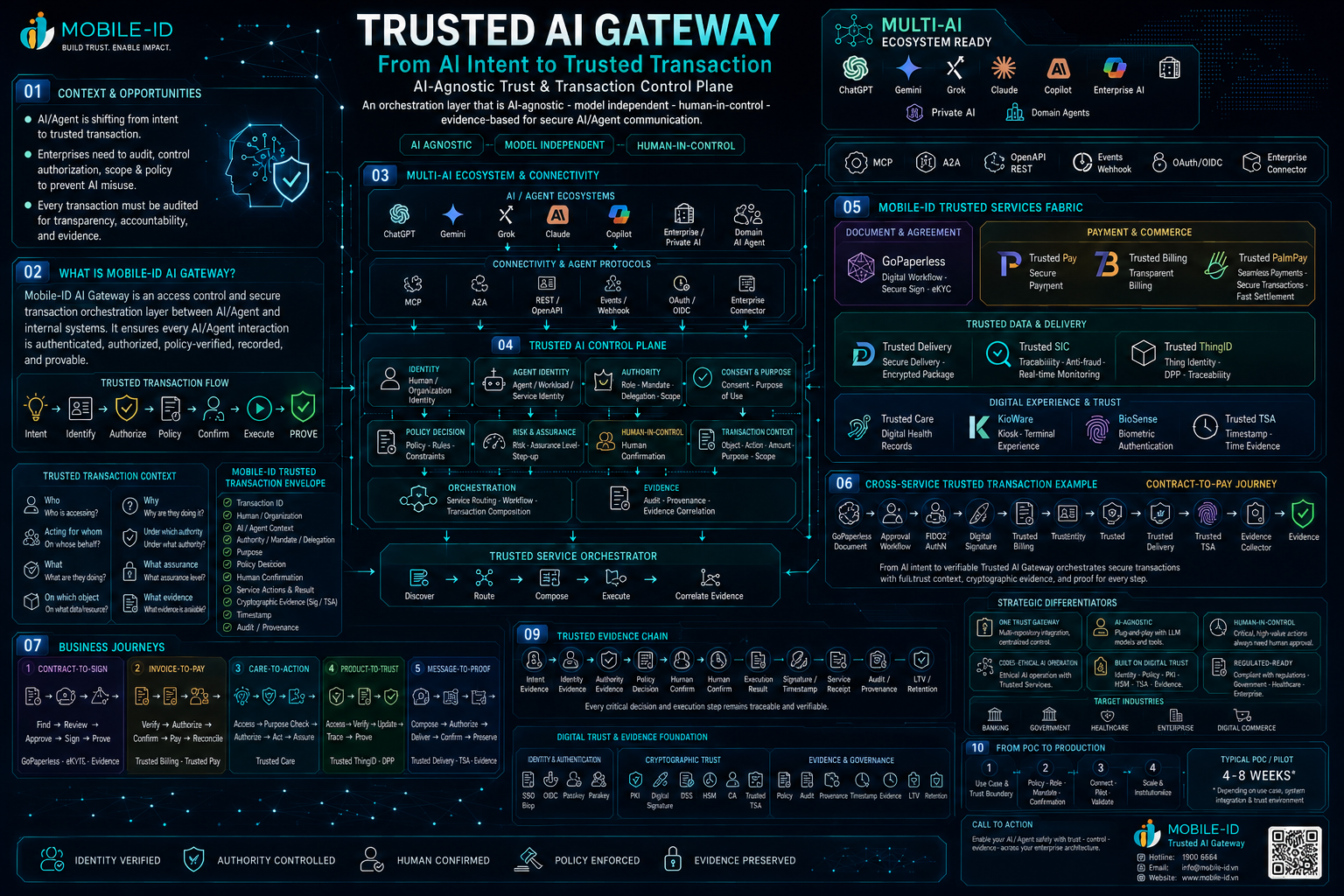
Overall Trusted AI Gateway architecture
The Sales Kit is a consolidated map of positioning, the Multi-AI ecosystem, the control plane, the trusted service ecosystem, business journeys, the evidence chain, and the PoC roadmap. Select the image to zoom in.
Every material decision must leave a trace that can be queried, linked, and independently verified.
A conversation transcript is useful for debugging but is not sufficient as transaction evidence. The evidence chain must link intent, identity, authority, policy decisions, user confirmation, and trusted execution results within one correlated context.
Identity & Permissions
SSO · OIDC · Passkey · User identity · AI agent identity · Role · Mandate · Delegation · Scope.
Cryptographic trust
PKI · e-Signing · DSS · HSM · CA · TSA · signature and timestamp references.
Evidence & governance
Policy version · Audit log · Provenance · Correlation · Evidence · Retention · LTV.
Cloud, on-premise, or hybrid — decided by the data boundary and trust boundary, not by AI trends.
Trusted AI Gateway can be deployed to fit the enterprise architecture. For sensitive use cases, a Hybrid model lets you use an external AI channel while transaction authority, the control layer, and source data systems stay inside the enterprise zone.
Cloud
Fits PoCs or workloads that can run in the cloud; data minimization and connector scope limits still apply.
On-Premise
The trust control layer, integration, and evidence sit inside organizational infrastructure; the AI channel can be private AI or a controlled channel.
Hybrid
External AI receives only minimal context; transaction authority, backend integration, and evidence can be kept inside the organization.
AI / agent · controlled tool requests · only the minimal necessary context is passed.
Trusted AI Gateway · IAM · Policy · Enterprise systems / Trusted services · HSM/PKI/TSA · Evidence.
AI can run externally, but transaction authority and trust infrastructure can still be kept inside the enterprise.
Evaluating the solution through its advantages, trade-offs, and how Mobile-ID reduces deployment risk.
SWOT should not be used as one-sided marketing copy. Weaknesses and threats must be turned into architectural measures, mitigation strategies, and acceptance criteria for the PoC.
STRENGTHS
- AI-agnostic, model-independent.
- User + AI agent identity, with authority and delegation awareness.
- Policy enforced at execution time, human-in-control, evidence by design.
- Multi-service orchestration, reusing existing trusted services.
- Architectural flexibility across cloud / on-premise / hybrid.
WEAKNESSES
- Initial integration is more complex than a simple chatbot/API.
- Requires a suitable level of enterprise IAM/API maturity.
- Policy governance must be designed correctly from the start.
- Step-up authentication can create friction if policy is too conservative.
- Part of the experience depends on the host AI platform.
OPPORTUNITIES
- Adoption of Agentic AI and enterprise AI governance is rising.
- Deployment opportunities across banking, government, healthcare, and commerce.
- A multi-AI strategy reduces vendor dependency.
- Growing demand for traceability of AI-initiated actions.
- Cross-sell potential across coordinated trusted services.
THREATS
- Large cloud providers (hyperscalers) may add native AI agent governance capabilities.
- Protocols/APIs change quickly.
- Risk of vendor lock-in and regulatory divergence across markets.
- Data leakage, shadow AI, and tool misuse.
- Security concerns could slow adoption.
How does Mobile-ID respond?
The value of a SWOT lies in the concrete mitigation strategy, not just in listing strengths and weaknesses.
A modular trust layer for AI transactions — customers are never forced to buy a massive bundle on day one.
The commercial model should track deployment scope and the modules used, rather than publishing assumed pricing on a blog. Customers can start with one use case, one AI channel, and one trusted service, then expand gradually.
PoC
Prove out the user experience and trust controls on one journey with clear business impact.
- 1 AI channel
- 1–2 services
- Focused policy/evidence
- PoC KPIs measured
Enterprise
Expand connectors and workflows with shared governance.
- Multi-AI / multiple services
- Enterprise IAM/API
- Centralized policy & audit
- HA/observability on demand
High-control enterprise
Designed for environments that require strict control, evidence, and deployment boundaries.
- Hybrid/on-premise choice
- HSM/PKI/TSA integration
- SIEM/audit integration
- Evidence governance & lifecycle
Strategic differentiation
One trust boundary for many AI ecosystems.
Never locks the transaction architecture into a single LLM.
One intent coordinates multiple trusted services.
Identity · PKI · HSM · TSA · Evidence.
People retain decision authority whenever policy or risk requires it.
Designed for environments requiring strong audit and evidence; not a certification claim.
Customers can start small with one use case, one AI channel, and one trusted service, then expand module by module.
Every industry has a different trust journey; every decision-maker needs a different reason to invest.
Banking
Approvals · payments · e-signing · service requests with risk-adaptive control.
Government
Authority · delegation · audit · evidence · hybrid/on-premise integration.
Healthcare
Purpose of use · consent · role/delegation · control over sensitive actions.
Enterprise
Contracts · invoices · approvals · handoffs · cross-department workflows.
Digital commerce
Payment · verification · delivery · reconciliation with fewer app switches.
| Decision-maker | Concern | Value they need to see |
|---|---|---|
| CIO / CTO | Architecture · integration · scalability · multi-AI platform. | One control plane, a reusable technical contract, and a vendor-flexible AI layer. |
| CISO | Identity · least privilege · policy · data boundaries · evidence. | Model context is never treated as authority; it is re-verified at the execution boundary. |
| COO | Faster processes · fewer handoffs · higher operational efficiency. | One intent can orchestrate multiple trusted capabilities. |
| Product / Digital | Natural AI interaction · adoption · channel expansion. | One unified conversational touchpoint that never weakens the trust control layer. |
| Compliance / Legal | Consent · purpose · authority · auditability. | Policy, approvals, and evidence are first-class transaction components. |
Every decision-maker needs to see a different value: architecture, security, operational efficiency, experience, or auditability.
Choose a journey realistic enough to measure both user convenience and the effectiveness of trust control.
Typical PoC target: 4-8 weeks, depending on integration scope. This is planning guidance, not a fixed commitment. A PoC should demonstrate real business impact, a clear policy gate, and verifiable evidence.
Use case & trust boundary
Actors · source systems · business impact · data boundary · success criteria.
Policy + roles + delegation
Authority model · tool contract · risk levels · confirmation/step-up rules.
Connect + test + validate
One AI channel · 1-2 services · success/failure/retry/evidence flows.
Scale + govern
KPIs · security review · RACI · real deployment architecture · scale-up plan.
A good PoC must measure user experience, policy correctness, integration effort, and evidence completeness at the same time.
Short, structured definitions so readers, search engines, and AI retrieval systems share the same vocabulary.
This glossary reduces ambiguity between gateway, agent, delegation, and evidence. The protocol links below point to official documentation and should be re-verified at publish/update time, since AI platform capabilities change quickly.
- AI Agent
- An AI component that can plan and use tools to achieve a goal within a granted scope.
- AI Gateway
- An intermediary layer that routes or controls traffic, models, and tool integration; specific capability depends on the product.
- MCP
- Model Context Protocol — a standardized protocol for how AI applications connect to tools and context.
- A2A
- Agent2Agent — a protocol for interoperability and coordination between agents where the connection model fits.
- OIDC
- OpenID Connect — an identity layer on top of OAuth 2.0 used to authenticate a subject and obtain identity claims.
- Agent Identity
- A distinct identity for an agent, workload, or service; it never substitutes for user or organizational identity.
- Mandate
- The basis that allows an actor/agent to act on behalf of a subject or organization within a defined scope.
- Delegation
- Transferring a limited portion of authority, with conditions and a time limit.
- Purpose-of-Use
- The business purpose for which data or an action is permitted to be used/performed.
- Policy Decision
- The result of evaluating rules/constraints against transaction context: allow, step-up, or deny.
- Assurance
- The confidence level in identity, authentication, and context used to decide whether an action qualifies.
- Trusted Transaction
- A transaction with identity, authority, policy, execution, and evidence under structured control.
- Evidence
- The components that prove a decision or execution, including receipts, audit references, signatures/timestamps, or related proof.
- Provenance
- The origin and chain of transformation of data or evidence, linked over time.
- TSA
- Time-Stamping Authority — the authority/service that provides trusted timestamps for data and evidence.
- LTV
- Long-Term Validation — the ability to keep evidence or signatures verifiable over time.
Technical references · verified 08/24/2026
- OpenAI Developers — Responses / tools and MCP capability
- Google AI for Developers — Gemini function calling / Remote MCP
- Google Developers Blog — Agent2Agent (A2A)
- xAI Docs — Function Calling · Remote MCP
- Anthropic Docs — Model Context Protocol
- Microsoft Learn — Copilot Studio tools, connectors, MCP and workflows
Integration capability claims must be re-verified at deployment time. Platform names/trademarks belong to their respective owners; this list does not imply partnership or certification.
Consistent terminology helps customers, search engines, and AI systems understand the same architecture correctly.
OpenAI Responses supports function/custom tools and MCP tools; Gemini supports function calling and Remote MCP; Google has announced A2A for agent-to-agent interoperability; xAI supports function calling and Remote MCP; Anthropic supports MCP across related products/APIs; Microsoft Copilot Studio supports connectors, MCP servers, and workflows. Specific capability must still be verified at deployment time.
12 questions that commonly come up in pre-sales, architecture review, and PoC scoping.
Is Trusted AI Gateway an LLM Gateway?
No. An LLM Gateway typically focuses on model access, routing, and operational observability. Trusted AI Gateway focuses on identity, AI agent identity, authority, delegation, policy, risk-based control, trusted execution, and the evidence chain for the transaction.
Is ChatGPT required?
No. The architecture is AI-agnostic; the AI channel can be Gemini, Grok, Claude, Copilot, Enterprise AI, Private AI, or Domain Agents, depending on actual integration capability.
Are Gemini, Grok, and Claude supported?
The architecture has integration patterns via function/tool calling, MCP/API, and suitable agent mechanisms. Specific capability must be re-verified against each official platform API at deployment time.
Can an AI agent pay or sign a document on its own?
Only when transaction policy allows it, authority/delegation is valid, and the risk level does not require user confirmation. High-impact actions should apply step-up authentication and/or explicit confirmation.
How does Human-in-Control work?
Confirmation is triggered by policy and risk, not on every action. Low risk can execute directly; medium risk requires step-up authentication; high risk requires explicit confirmation; prohibited actions are blocked.
How is an AI agent’s authority determined?
AI agent identity is kept separate from user/organization identity and is tied to role, mandate/delegation, scope, purpose, tenant, and transaction context.
Is on-premise deployment supported?
It can be designed as cloud, on-premise, or hybrid depending on data boundaries, trust boundaries, and existing systems. The final deployment model needs an architecture review.
Does all enterprise data have to be sent to the AI?
No. The design prioritizes data minimization: the AI model receives only the context needed for the tool/action; secrets, private key material, and out-of-scope data should never enter the model context.
What evidence does Trusted AI Gateway generate?
Depending on the use case: normalized intent, identity/authority evidence, policy decisions, user confirmation, execution results, receipts, signature/timestamp references, audit/provenance logs, and retention/LTV metadata.
Can it connect to existing systems?
Yes. The Gateway can use REST/OpenAPI, events/webhooks, enterprise connectors, MCP/tool adapters, or an integration mechanism suited to the existing system.
Do we need to replace our existing API Gateway?
Not by default. Trusted AI Gateway adds a control layer for AI-initiated transactions and can work alongside an existing API Gateway rather than replacing it.
Which use case should a PoC start with?
Choose a journey with clear business impact, policy that is easy to model, and measurable KPIs — for example, Contract-to-Sign, Invoice-to-Pay, Message-to-Proof, or Product-to-Trust.
Mobile-ID will build your trusted transaction roadmap.
Start from one journey with real business impact. The discovery phase will define the AI channel, trust boundary, identity/authority, tool contract, policy gate, trusted services, evidence model, and PoC KPIs before scaling.
KEEP IDENTITY, AUTHORITY, POLICY, AND EVIDENCE UNDER ENTERPRISE CONTROL.
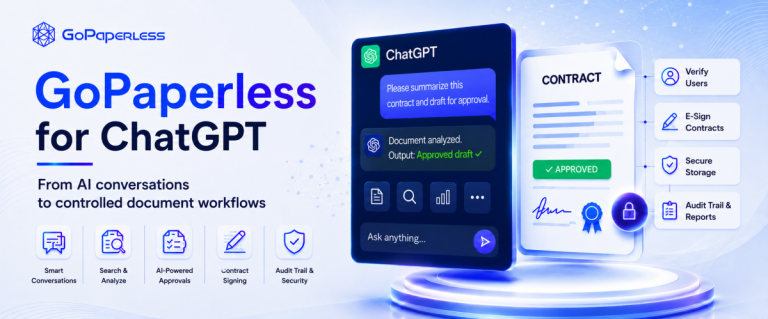
- Mobile-ID Blog — GoPaperless for ChatGPT, editorial style reference: product experience + architecture + business value + PoC roadmap.
- Platform/protocol documentation is listed in section 17 · Knowledge layer, prioritizing official documentation.
This article describes the product positioning and conceptual architecture of Trusted AI Gateway. Protocol/API capability must be re-verified at deployment time; naming AI platforms does not imply partnership or certification.


Community Discussion