


KioWare v2: Secure Kiosk Middleware Platform with Integrated Digital Identity
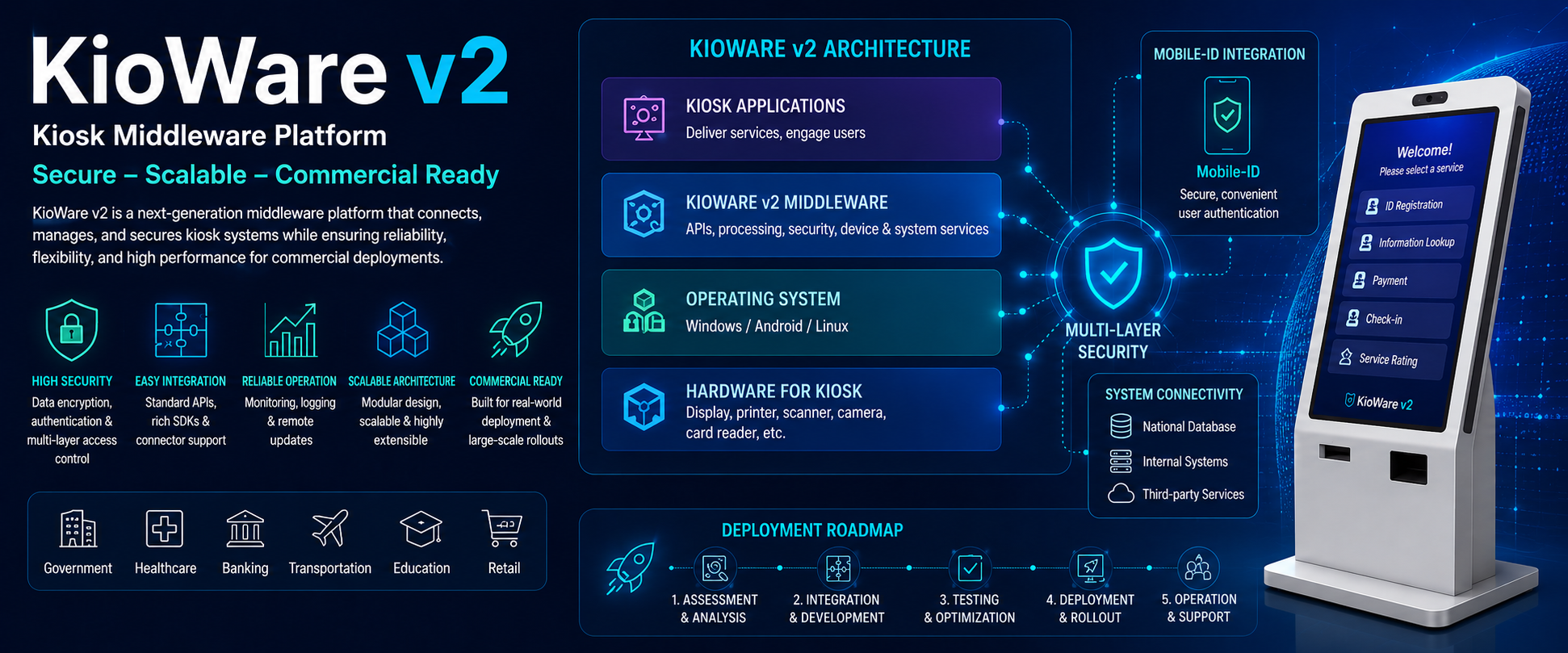
KioWare is more than just browser-locking software or a standard remote kiosk management tool. When built on a clearly layered architecture, KioWare v2 can become a comprehensive kiosk middleware platform — standardizing application communication, abstracting peripheral devices, integrating authentication and authorization with the Mobile-ID ecosystem, and packaging into commercial solutions for government, banking, healthcare, retail, and large-scale self-service models.
Experience Layer
Kiosk applications, mini-apps, self-service workflows, vertical business flows, and digital counter operational interfaces.
KioWare Middleware Layer
Local API, session management, authentication/authorization, policy management tools, secure storage, event bus, plugin runtime, and offline queue.
Peripheral / HAL (Hardware Abstraction) Layer
Standardizes camera, printer, QR/barcode scanner, NFC/RFID, payment terminal, GPIO, digital signature pad, and biometric reader.
Control Plane (Central Control Tier)
Device provisioning, monitoring, remote configuration, command queue, application catalog, deployment, audit, analytics, and tenant management.
Security & Identity (Trust Layer)
Mobile-ID ecosystem integration for OIDC/OAuth2, device identity, step-up authentication, consent, and signed trust services.
What is KioWare? What is kiosk middleware?
KioWare is specialized software for kiosk environments, originally focused on browser locking and remote device management. In version 2, KioWare is repositioned as a kiosk middleware platform — a software intermediary layer that standardizes all communication between business applications, peripheral hardware, management systems, and digital identity services.
Kiosk middleware is a software layer between the business application and the kiosk hardware, providing a unified API surface so applications can interact with cameras, printers, NFC, payment devices, and other peripherals — without worrying about differences between device models or manufacturers.
The market is ready for a technologically deep kiosk platform
Most kiosk projects today are still deployed in a fragmented manner: a browser-lock layer, a few remote management utilities, and each application handling peripheral devices its own way. This increases vendor dependency, makes scaling difficult, and drives up repeated integration costs. KioWare v2 has the opportunity to break out by positioning as a middleware platform — where the kiosk becomes a true digital service point, not just a locked display screen.
Businesses and public service agencies need to reduce counter pressure, shorten wait times, and expand digital touchpoints at physical locations — without proportionally increasing operational staffing costs.
Modern kiosks must interact with digital identity, QR payments, loyalty rewards, cameras, NFC, eKYC, digital signing, and electronic documents — they are no longer simple locked display devices.
Customers need a solution that allows third parties to integrate quickly while maintaining centralized management, full security, and audit trails. This is a clear gap for an API-first kiosk middleware like KioWare.
Verticals with the Highest Commercial Potential
Why Vietnam Is the Right Market for KioWare
- Demand for digitizing transaction points and automating service counters remains significant, particularly in e-government, healthcare, banking, and service chains.
- The QR payment, VNeID, eKYC, remote digital signing, and loyalty reward ecosystems are opening many high-value real-world kiosk use cases.
- Customers increasingly want to shorten integration time and avoid deep dependency on a single hardware vendor or standalone system integrator.
- Tied to the Mobile-ID ecosystem, KioWare differentiates through trust, digital identity, authorization, and compliance capabilities — far beyond standard “kiosk control.”
KioWare’s Market Positioning Statement
KioWare is a secure kiosk middleware platform that enables enterprises to deploy large-scale digital service points through a standardized communication layer for applications, peripheral devices, security policies, and trust services. The result: reduced integration costs, faster deployment, and the elevation of kiosks from display devices to true digital service infrastructure with transactional value.
Layered design — the foundation for sustainable kiosk middleware scaling
A kiosk platform built for longevity must ensure that business applications do not communicate directly with hardware. Middleware must become the central abstraction layer: standardizing device capabilities, controlling access, and absorbing differences between various device types.
Business applications, mini-apps, and vertical self-service workflows
- Web, native, hybrid, or packaged plugin applications running in the kiosk runtime environment.
- Supports use cases: self check-in, administrative document intake kiosk, smart bank branch, self-service payment, ordering, loyalty points, and visitor management.
- Communicates only through the middleware API — no direct dependency on individual hardware drivers.
Core technical coordination layer for the entire system
- Local API gateway handling all requests from applications running in the kiosk.
- Manages sessions, validates and verifies tokens, enforces security policies, provides secure local storage, maintains an offline queue, and routes events.
- Standardizes device capabilities through a unified API: image capture, printing, QR/barcode scanning, NFC/RFID reading, payment calls, GPIO control, and biometric data collection.
Peripheral device abstraction — decoupling hardware from business logic
- Transforms the diversity of printer models, cameras, scanners, NFC readers, and payment terminals into stable, consistent interfaces for application developers.
- Allows hardware replacement or upgrades without affecting business application logic.
- Significantly reduces maintenance and re-integration costs when scaling or deploying across multiple locations.
Centralized management for large-scale kiosk networks
- Device registration, tenant management, application catalog, remote configuration, status monitoring, operational data collection, and command queue.
- Software package deployment, version management, feature flags, staged rollout by kiosk group or vertical.
- Collects audit logs, operational events, and quality analytics across the entire kiosk network.
Strategic differentiation through Mobile-ID ecosystem integration
- OIDC/OAuth2 for users, applications, and devices — synchronized with the Mobile-ID digital identity infrastructure.
- Supports step-up authentication, electronic consent, digitally signed events, remote approval, remote signing, and identity-based workflows.
- Elevates kiosks into the high-trust transaction tier — with evidence, audit trails, and legal validity.
Third parties only need to learn a single API surface to integrate the entire kiosk
The greatest value of KioWare for development partners lies not in the list of supported devices, but in how simple the API is to call. When middleware standardizes authentication, authorization, sessions, peripheral access, and event models, integration costs drop significantly and the number of applications that can be built scales horizontally without refactoring the core.
API Design Principles to Maintain Consistently
- Capability-based design, not dependent on specific device models.
- Local-only endpoints by default to minimize attack surface.
- JWT, mTLS, and signed assertions for application, user, and device identity.
- Policy-based access: clear rules on which application can use which device, in which context.
- Offline-first priority: local queues, retry logic, and buffers for audit and events.
Example API Call via KioWare Middleware
Clear interaction flow: simple for developers, rigorous for operations
Good architecture must show a clear data path: the application calls middleware, middleware calls HAL, and connects to the control plane and trust layer when needed. The diagram below describes the standard execution flow in a KioWare v2 environment.
The application is registered on the KioWare Server, receives an app identity, and is granted appropriate access permissions per device type.
The application runs in the kiosk, obtains a local token from middleware, and queries the current device capabilities available at that kiosk.
The application calls actions such as QR scanning, printing, image capture, or payment activation through the unified middleware API.
Middleware verifies authentication, authorization, session state, and security policies before routing the request down to HAL or the relevant service.
Audit logs and events are pushed to the control plane. Trust flows can call Mobile-ID to perform step-up authentication, electronic consent, or signed confirmation.
Solution packages that can be commercialized from the same KioWare platform
KioWare is more easily commercialized when packaged as vertical solution suites rather than just “kiosk software.” The same middleware core — with different business profiles, security policies, integration connectors, and interfaces — can produce multiple distinct products for different markets.
Digital Citizen Kiosk
Administrative document intake, procedure lookup, citizen authentication via national digital ID, electronic confirmation signing, receipt printing, fee payment, and queue management at public service points.
Smart Branch & Banking Self-Service
Counter-side eKYC, customer profile updates, electronic document signing, form issuance, step-up authentication, payment terminal integration, and bank-grade audit trails.
Healthcare & Patient Intake Kiosk
Queue number issuance, identity verification, appointment check-in, payment, examination slip printing, counter calling, and data synchronization with HIS/EMR systems.
Ordering, Loyalty & Self-Checkout
Food ordering, cashless payment, order pickup, loyalty point earning and redemption, self-checkout, and integration with POS or closed-loop wallets.
The real competitive advantage lies in the trust layer, not just kiosk control
When integrated with the Mobile-ID ecosystem, KioWare moves into a category of use cases with significantly higher value than traditional kiosk software. The kiosk becomes the start or end point of a digital transaction — with electronic evidence, identity authentication, fine-grained authorization, and full audit trails.
Identity-Aware
Devices, applications, and users all have distinct digital identities. This enables access decisions and trust levels to be controlled precisely by context — rather than applying rigid policies uniformly across the board.
Policy-Driven
Not every application is permitted to use every device. Middleware enforces permission scopes, roles, and policy rules per tenant or use case — at the middleware layer itself, independent of application self-enforcement.
Evidence-Ready
Transactions with consent steps, approvals, electronic receipts, confirmations, or digital signatures generate electronic evidence with higher legal and operational value than standard logs.
3 development phases: fast go-to-market while maintaining a long-term platform vision
KioWare doesn’t need to be a fully complete platform from day one. The right strategy is to build a solid core, commercialize early in a few key verticals, then gradually expand into trust services and partner ecosystems in phases.
Proposed Technical Roadmap in 3 Phases
Phase 1 — Core Middleware Platform
Build local API, policy sync, remote management, operational data collection, application packaging, camera/scanner/printer abstraction, and per-kiosk/location monitoring.
Phase 2 — Expand Trust Integration with Mobile-ID
Integrate Mobile-ID for OIDC/OAuth2, user session management, application identity, device identity, electronic consent, signed events, and advanced audit.
Phase 3 — Vertical Solution Packages & Partner Ecosystem
Package vertical solutions, publish SDKs, sample applications, workflow templates, pre-built integration connectors, and a developer partner marketplace.
Deployment Models KioWare Should Support
- On-premise: suitable for banking, government, healthcare, or customers requiring high data sovereignty and infrastructure control.
- Hybrid: control plane on cloud or private cloud, with trust services and sensitive data in the customer’s private zone.
- Managed service: suitable for service chains needing fast deployment of dozens to hundreds of kiosks across multiple locations.
- Multi-tenant SaaS: suitable for selling to partner ecosystems, system integrators (SIs), or multi-brand franchise operators.
Platform revenue + vertical revenue model — not just one-off project sales
Selling only “kiosk projects” yields low margins and limited repeatability. Selling KioWare as a multi-layered revenue platform delivers far greater long-term value: platform license fees, recurring management fees, trust service fees, integration fees, vertical solution packages, and long-term operational services.
Kiosk Core
For customers needing kiosk runtime, remote configuration, and basic peripheral abstraction.
- Device registration and policy synchronization
- Standardized camera, scanner, and printer APIs
- Status monitoring, heartbeat, and remote commands
- Application packaging and device capability discovery
Trusted Integration Platform
For customers needing advanced authentication/authorization, full audit, multi-tenant application management, and Mobile-ID ecosystem integration.
- OIDC/OAuth2 for applications, users, and devices
- Policy management tools and authorization enforcement
- Digitally signed events, electronic consent, evidence trails
- Packaging by tenant, location, and vertical
Vertical Solution Package
For packages such as smart bank branch, digital citizen kiosk, healthcare self-service, or retail self-checkout.
- Integration connectors and vertical workflow templates
- Full-cycle management services and deployment support
- Operational analytics, committed SLAs, priority support
- Integration consulting and vertical presales solutions
Why KioWare’s Commercial Potential Is High
- Solves a real problem: reducing complexity when applications need to interact with diverse kiosk hardware.
- Sellable across multiple value tiers — from platform licenses to vertical solution packages and trust services.
- Easily bundled with existing Mobile-ID services: digital identity, e-signatures, trust, QR payments, loyalty rewards, and digital workflows.
- Aligns with the trend of kiosks evolving into self-service points with higher transactional and digital identity value.
What Needs to Be Done Well to Win the Kiosk Middleware Market
- APIs must be extremely clean, consistent, and clearly documented so third parties want to integrate.
- HAL (driver abstraction) must be robust to reduce cost increases when changing device models.
- Control plane must be powerful enough to manage multiple locations, multiple tenants, and multiple product packages simultaneously.
- Market messaging must emphasize that KioWare is a trusted kiosk service platform — not just an upgraded kiosk browser.
Quick answers about KioWare v2 and the kiosk middleware platform
How is KioWare v2 different from standard kiosk software?
Standard kiosk software primarily locks browsers and manages devices remotely. KioWare v2 is repositioned as a kiosk middleware platform with a 5-layer architecture: standardized API for business applications, hardware abstraction (HAL), centralized multi-tenant management, and digital identity integration via Mobile-ID. This allows third parties to integrate quickly without directly communicating with individual device drivers.
How does KioWare integrate with Mobile-ID?
KioWare integrates with the Mobile-ID ecosystem through the Trust Layer using the OIDC/OAuth2 standard. This supports step-up authentication, electronic consent, digitally signed events, remote approval, and remote signing — enabling kiosks to become high-trust, legally valid transaction points.
Which industries is KioWare suitable for?
KioWare is best suited for 5 verticals: public administration (document intake kiosks, national ID authentication), banking/BFSI (smart branches, eKYC), healthcare (check-in, patient intake), retail (ordering, self-checkout, loyalty), and transport (ticketing, self check-in). All can be packaged from the same middleware core.
Why use a Hardware Abstraction Layer (HAL) in kiosk middleware?
HAL (Hardware Abstraction Layer) is the peripheral device abstraction layer that converts the diversity of printer models, cameras, scanners, and NFC readers into consistent API interfaces. Business applications don’t need to be rewritten when hardware models change, significantly reducing maintenance and integration costs when scaling to multiple locations.
What deployment models does KioWare support?
KioWare supports 4 deployment models: on-premise (suitable for banking, government), hybrid (control plane on cloud, sensitive data in a private zone), managed service (for service chains deploying quickly), and multi-tenant SaaS (for partner and SI ecosystems). Each model meets different data control and deployment speed requirements.
What is KioWare’s revenue model?
KioWare has 3 revenue tiers: Kiosk Core (platform license, basic APIs, monitoring), Trusted Integration Platform (OIDC/OAuth2, advanced audit, multi-tenant with Mobile-ID), and Vertical Solution Packages (integration connectors, workflow templates, SLAs, vertical consulting). This model generates recurring revenue rather than one-off project sales.
KioWare should evolve as modern kiosk service infrastructure — not just kiosk software
The right direction is not to incrementally add isolated features to the kiosk, but to build a middleware platform layer with a clean API, a standard layered architecture, strong trust integration, and the ability to package into multiple vertical solutions. When done right, KioWare can become a platform with lasting commercial appeal, opening up new revenue streams and elevating the value of the entire Mobile-ID ecosystem.




Community Discussion