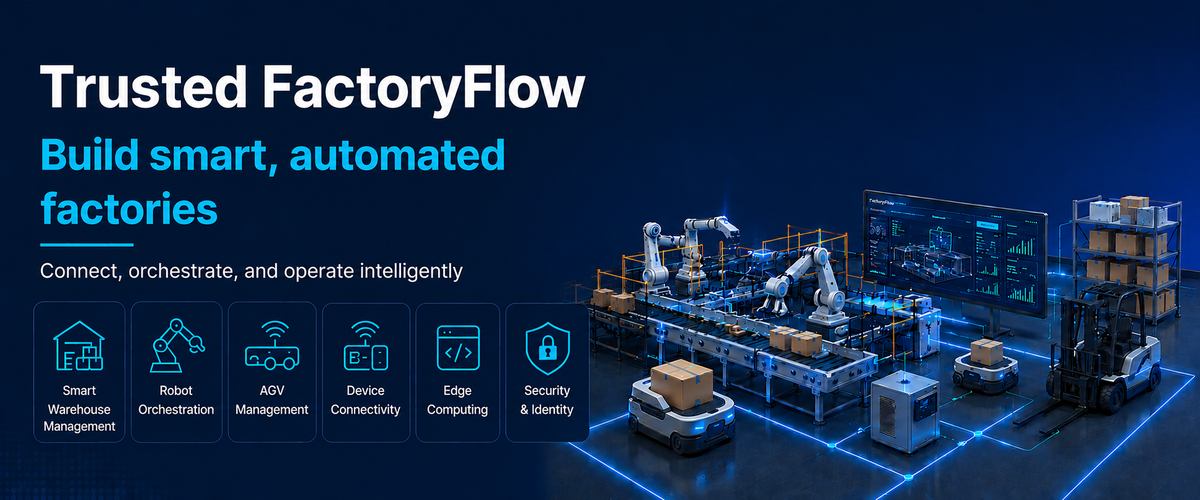
Trusted FactoryFlow – Smart Factory and Smart Warehouse Automation Platform
Smart Factory and Smart Warehouse

Turning factory movement into a controlled, traceable digital flow

Trusted FactoryFlow connects WMS records, WCS execution, AMR missions, robot cell jobs, industrial devices and edge runtime into one event-driven automation platform for manufacturing, warehouse and logistics operations.

By Mobile-ID Solution ArchitectureTechnical blog

Why FactoryFlow matters in real operations

Factories often start automation by buying robots. The harder problem is not the robot itself; it is the controlled flow of tasks, stock, routes, devices, exceptions and evidence across business systems and factory-floor equipment.

Trusted FactoryFlow is designed as an integration and execution platform. It keeps ERP and MES as enterprise planning systems, WMS as the inventory and task system of record, WCS as the execution orchestrator, Fleet as the mobile robot mission owner, Robot Cell as the cell job owner, and Device Adapter as the boundary to AMR, PLC, cobot, scanner, printer, scale, conveyor and vision systems.

Core principle: WCS, Fleet, Robot Cell and Device Adapter services can coordinate execution, but they do not directly update inventory. Inventory movement remains controlled by the WMS domain, with correlation, audit and exception handling.

Reference architecture: from enterprise API to factory edge

The architecture follows a layered, enterprise-ready model: channels enter through WSO2 API products, identities and service accounts are governed by Keycloak, domain services run independently on Java/WildFly, MariaDB is owned per service, Kafka coordinates service interaction, and edge runtime keeps low-latency execution close to the factory floor.

Technical capabilities that make the solution build-ready

1

WMS and task ownership

Manages SKU, stock balance, movement, reservation, receiving, putaway, transfer, replenishment, picking, packing and cycle count with strict state transitions.

2

WCS execution orchestration

Plans execution orders, dispatches tasks to AMR, robot cell or manual path, handles pause/resume/abort and opens exceptions when execution fails.

3

Fleet and AMR mission lifecycle

Tracks robots, status, missions, pickup/dropoff evidence, charging policies, route blocking and traffic-zone decisions.

4

Robot Cell and PLC handshake

Controls recipe approval, cell jobs, quality results, PLC readiness, cycle completion, fault handling and safety-stop event capture.

5

Device Adapter Gateway

Abstracts vendor-specific protocols behind common command and callback contracts for AMR, PLC, cobot, conveyor, scanner, printer, scale and vision systems.

6

Factory Edge runtime

Runs local WCS, device gateway, local queue/cache and sync agent to continue allowed in-flight work during WAN outage.

How the platform works in a material delivery scenario

In a practical deployment, the AMR delivery flow becomes a choreography instead of a point-to-point integration. Every important state change is captured as an event, making the operation observable, auditable and recoverable.

1. Material demand is received

MES or line station creates a material call. Integration Hub validates and publishes the demand with a correlation ID.

2. WMS reserves stock and releases a task

Inventory verifies availability, creates a reservation and WMS Task releases the transfer or replenishment task.

3. WCS creates and dispatches execution

WCS converts the released task into an execution order, applies routing rules and dispatches it to Fleet.

4. Fleet manages the AMR mission

Fleet selects a robot based on availability, route, payload and battery, then tracks pickup, load, dropoff and completion events.

5. WMS confirms movement and reporting updates KPIs

Completion evidence returns through WCS and WMS; stock movement is posted, audit is recorded and dashboards refresh.

Security, safety and governance by design

The platform separates enterprise security from OT safety. WSO2 and Keycloak enforce API security, OAuth2/OIDC scopes, client identity, mTLS, request signatures and audit logging. Safety-critical control remains local and independent of cloud connectivity.

Control area Implementation practice Operational value
API security WSO2 policies, JWT validation, mTLS, throttling and payload schema validation. Prevents uncontrolled channel and partner access.
Identity and access Keycloak realms, roles, scopes, clients, service accounts and token claims. Gives operators, services and devices least-privilege access.
Event reliability Transactional outbox, consumer inbox, idempotency keys, retry and DLQ. Supports safe retries and operational recovery.
OT segmentation No direct cloud-to-PLC path; commands flow through edge/device gateway allowlists. Reduces lateral movement and unsafe remote control risk.
Safety boundary E-stop, safety PLC and safety-rated controls remain local. Keeps human and equipment safety independent from software availability.

Deploying FactoryFlow in the real world

A practical rollout should begin with a focused pilot, not a broad digital twin ambition. The recommended first deployment is AMR-based material delivery and line-side replenishment because it proves WMS/WCS/Fleet boundaries, edge runtime and ROI without starting from the highest robotics complexity.

A

Core platform

Deploy WSO2, Keycloak, Kafka, MariaDB, object storage, observability and core microservices in a secure core environment.

B

Factory edge

Deploy edge WCS, device gateway, local queue/cache and sync agent at the site to support low-latency execution and offline tolerance.

C

Simulators first

Run AMR, PLC, cobot, scanner, printer, scale and ERP/MES simulators before real hardware and vendor sandbox integration.

D

Controlled go-live

Use FAT, SAT, UAT, safety sign-off, runbooks, dashboards and KPI baseline before promoting the pilot to live operations.

A phase-based rollout roadmap

Phase Scope Exit criteria
Foundation design Architecture delta, scope, APIs, DB, Kafka, security and backlog. Architecture board approves scope and artifact plan.
WMS expansion Cycle count, FEFO/FIFO, wave, pick, pack and labor task expansion. Inventory and task flows pass API, DB, event and UAT tests.
WCS/Fleet optimization Routing optimization, traffic control, charging policy and route block management. Simulator scenarios pass for blocked routes, low battery, priority and re-dispatch.
Device/OT expansion PLC, cobot and conveyor adapter contracts, callbacks and alarm model. Adapter simulator and hardware sandbox test plan approved.
Edge and dashboard Local dashboard, replay monitoring and sync conflict handling. WAN outage, replay and conflict-resolution tests pass.
Pilot hardening FAT, SAT, UAT, security review, DR, runbooks and KPI baseline. Go/No-Go checklist signed by business, delivery, security and site operations.

What implementation teams should build first

The fastest path to a credible pilot is to produce real build artifacts from the specification: OpenAPI YAML, Flyway migrations, Kafka schemas, WSO2 product configuration, Keycloak realm export, service skeletons, simulator scenarios, automated tests and runbooks.

Implementation rule: every expansion capability must have an API contract, database migration, Kafka contract, security rule, simulator case, acceptance test and dashboard signal before it is considered release-ready.
Artifact Why it matters Who uses it
OpenAPI YAML Defines stable REST contracts for WSO2, backend and QA. API platform, backend, QA, integration partners.
Flyway migrations Turns logical schema into reviewable, repeatable database change. Backend, DBA, DevOps.
Kafka schemas Controls event compatibility and producer/consumer contracts. Platform, service teams, reporting.
Simulator scenarios Allows AMR/PLC/cobot/conveyor testing before hardware is ready. Robotics, QA, delivery.
Runbooks and dashboards Make operations measurable and recoverable during pilot. Support, delivery, site operations.

Ready to move from automation concept to controlled factory execution?

Start with a site survey, data readiness check, simulator demo and AMR material-delivery pilot. Use the release gates to keep architecture, safety, security and operations aligned before live rollout.

Back to top
MI
Mobile-ID Solution Architecture
Enterprise architecture, smart warehouse automation, robotics integration and digital trust implementation planning.

Community Discussion

Related Posts

KioWare v2 – Secure Kiosk Middleware & Digital Identity Platform

KioWare v2 – Secure Kiosk Middleware & Digital Identity Platform

Kiosk · Middleware · Mobile-ID Ecosystem KioWare v2: Secure Kiosk Middleware Platform with Integrated Digital Identity KioWare is more than just browser-locking software or a standard remote kiosk management tool.…
Trusted Care – a Health Kiosk & API platform for digital health infrastructure and healthcare data

Trusted Care – a Health Kiosk & API platform for digital health infrastructure and healthcare data

Digital Health · Health Kiosk · API First Trusted Care: transform health measurement points into trustworthy data infrastructure In the digital healthcare era, value is not merely in blood pressure…
Trusted IoT Connectivity & Tracking - a trusted IoT architecture for logistics, cold chain, and enterprise operations

Trusted IoT Connectivity & Tracking – a trusted IoT architecture for logistics, cold chain, and enterprise operations

Technical Blog v2 | In-depth Technical Style | Mobile-ID-standard Layout When logistics, cold-chain and container tracking enter real operational environments, customer requirements go beyond “the device can send data.” What…
Quantera AI WorkSphere – on-premise AI agents for secure enterprise productivity and workflow management

Quantera AI WorkSphere – on-premise AI agents for secure enterprise productivity and workflow management

On-premise agentic AI productivity appliance Quantera AI WorkSphere is a secure on-premise agentic AI appliance engineered for enterprises that require governed document ingestion, AI-assisted drafting, department-level agent workflows, read-only system…
This website uses cookies

By clicking "Accept all", you agree to the storing of cookies on your device to enhance site navigation, analyze site usage, and assist in our marketing efforts.

Custom cookie preferences

These cookies are required for the website to function properly. They do not collect data for advertising purposes and cannot be disabled, as this would break the site's basic functionality.

Always active

These cookies remember your choices and settings to provide a more personalized experience, such as your selected language, dark/light theme, font size, region, or other customizations.

These cookies help us understand how visitors interact with the site. All data is fully anonymized and used solely to improve site performance, loading speed, and content quality—no personal identification.

These cookies enable us to show you more relevant ads on our site and across other platforms. They anonymously track your browsing behavior and prevent the same ad from appearing repeatedly.

Home Posts Contact mobile-id.vn

Ngôn ngữ / Language