


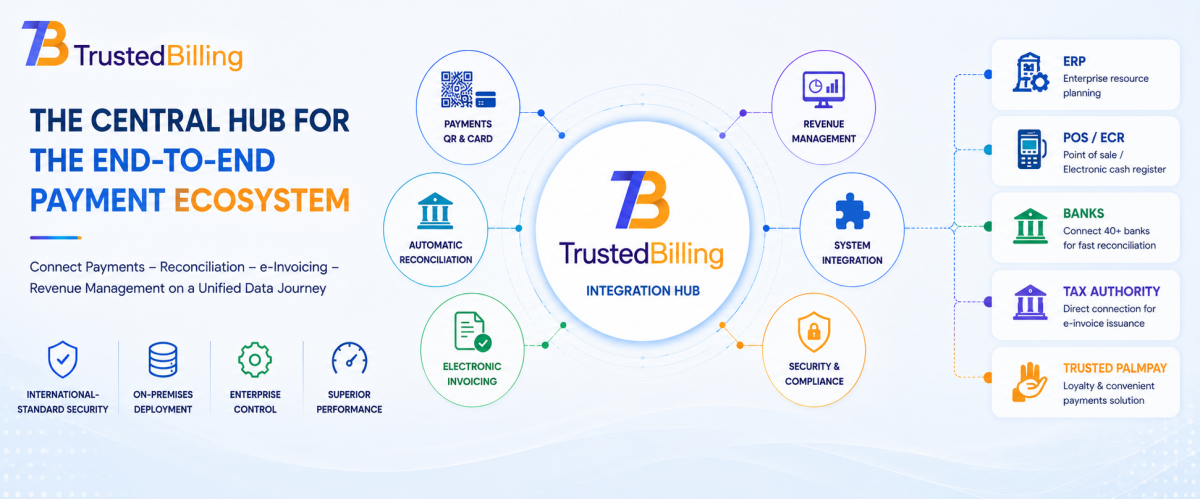
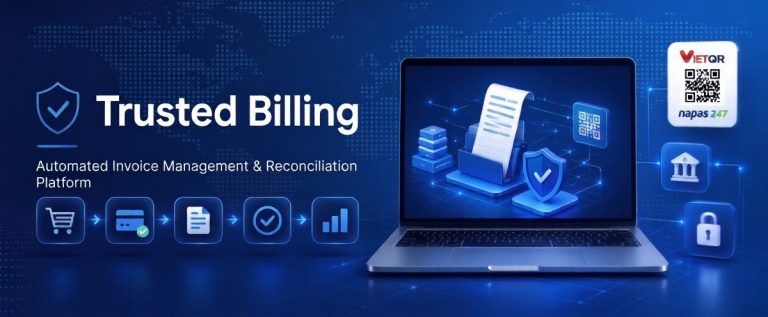
Trusted Billing – Mobile-ID’s End-to-End Payment Ecosystem
From accepting QR or palm payments at the point of sale to transaction confirmation, reconciliation, e-invoicing, loyalty and management reporting — Trusted Billing acts as the central orchestrator so revenue data flows seamlessly end to end.
Disclosure Details
Notice 664/TB-CT and the online consolidated list are two separate reference sources. The position number on the online list may change whenever the tax authority updates it.
Notice No. 664/TB-CT dated 07/27/2026 gives businesses another basis for evaluating Mobile-ID’s e-invoicing capability. Building on that, Trusted Billing is positioned as the central orchestration layer, able to combine with Trusted Pay and Trusted PalmPay to connect the journey from point of sale, payment and reconciliation through to e-invoicing and revenue management.
Key Takeaways
- On 07/27/2026, the Tax Department published Notice No. 664/TB-CT confirming that Mobile-ID meets the full criteria for providing e-invoicing solutions.
- Trusted Billing is the central orchestration layer, connecting payments, reconciliation and e-invoicing with a business’s existing ERP, POS and ECR.
- Businesses can start from one specific problem — invoicing, reconciliation, QR or palm payments — then expand gradually along a 5-stage maturity roadmap.
- Trusted Pay and Trusted PalmPay are two platforms that can be added on when needed; businesses are not required to deploy all three at once.
- The reference pilot phase runs 2–4 weeks on a controlled data scope before moving to full rollout.
Mobile-ID publicly confirmed as fully meeting the criteria under Circular 32/2025/TT-BTC
On 07/27/2026, the Tax Department – Ministry of Finance issued and digitally signed Notice No. 664/TB-CT disclosing the organizations providing e-invoicing solutions that fully meet the criteria set out in Clause 1, Article 11 of Circular No. 32/2025/TT-BTC dated 05/31/2025 of the Ministry of Finance. The digital signature timestamp shown on the document is 14:57 on 07/27/2026.
The notice records Mobile-ID Technologies and Services JSC, tax code 0313994173, along with its service page https://trustedbilling.mobile-id.vn/. This article does not use the sequence number inside Notice 664/TB-CT itself as Mobile-ID’s position on the online consolidated list.
What does the notice confirm?
- Mobile-ID is publicly confirmed by the Tax Department as meeting the full criteria for providing e-invoicing solutions.
- The scope covers both coded and non-coded e-invoicing solutions issued by the tax authority.
- The disclosure gives businesses an additional basis for evaluating the solution provider.
Scope to understand correctly
- Notice 664/TB-CT should not be described as a standalone license.
- Bank connectivity, reconciliation and ERP/POS/ECR integration are capabilities of the Trusted Billing product.
- Technical scope, rollout timeline and service level are agreed on a per-project basis.
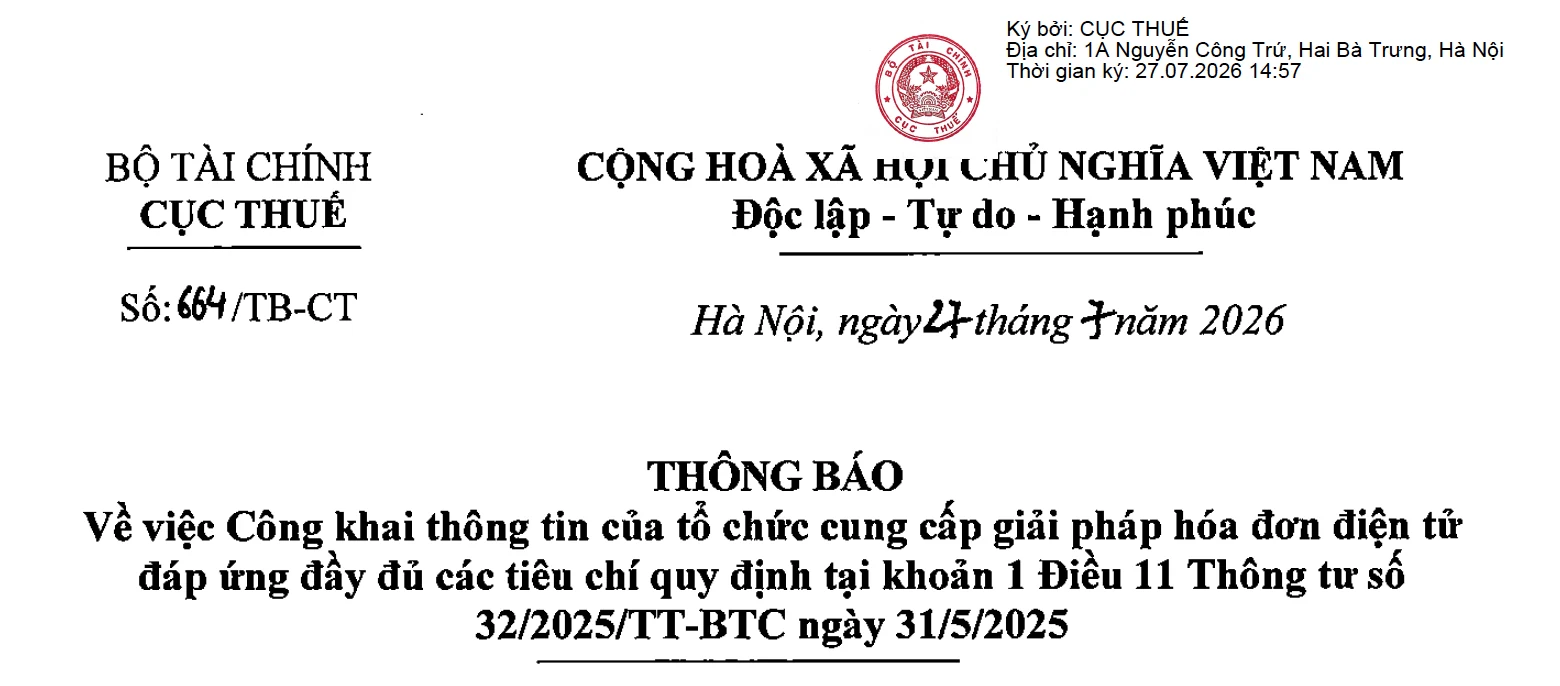
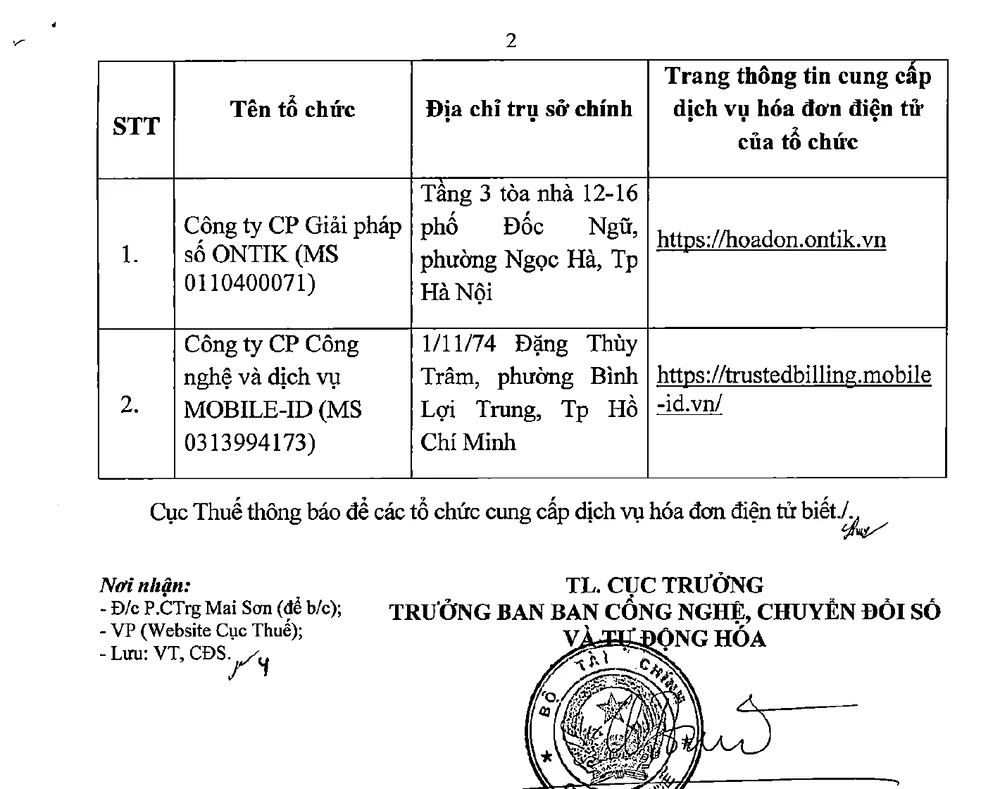
Mobile-ID’s information on page 2 of the notice
The disclosed section shows the organization’s name, tax code, head-office address and the service page for Mobile-ID’s e-invoicing offering. The sequence number in each notice’s table is not meant to be used as a position on the online consolidated list.
Cross-checked against the tax authority’s public online list
This information is presented separately from Notice No. 664/TB-CT to avoid confusion over source and sequence number.
Note: No. 131 is the position shown on the online consolidated list as of this article’s update on 07/28/2026; it is not the sequence number in Notice 664/TB-CT and may change whenever the tax authority updates the list.
Capture Incoming Payments
Receive balance changes and payment data through the appropriate integration method.
Automated Reconciliation
Match incoming funds against orders, contracts or receivables using business rules.
E-Invoicing Orchestration
Send issuance requests and track responses from the e-invoicing provider.
Reporting and Audit Trail
Manage status, processing history and exceptions from one central dashboard.
From a single payment transaction to a complete revenue process
Businesses need more than confirmation that a customer has paid. A complete transaction must also be tied to the right point of sale, the right order or receivable, moved into the e-invoicing process, reflected in loyalty updates, and made ready for reporting, reconciliation and audit.
Mobile-ID’s three platforms can be combined to fit the required scope. Each platform owns a distinct business layer; Trusted Billing is the central hub for revenue and invoice data orchestration.
Trusted Pay
Supports QR payments, transaction notifications, point-of-sale management, cash-flow tracking and loyalty programs.
- QR payments and transaction alerts
- Merchant, store and staff management
- Loyalty and transaction data
Trusted Billing
Ingests data from payment touchpoints and business systems to match orders, manage exceptions, orchestrate e-invoicing and return status to ERP/POS/ECR.
- Reconciling incoming funds against orders and receivables
- Orchestrating the e-invoice lifecycle
- Centralized reporting and audit logging
Trusted PalmPay
Connects palm-based identity, controlled payment, stored value, Open Banking and loyalty for high-frequency points of sale.
- Palm Vein / Palm Print
- VNeID-assisted onboarding and consent
- Payments, loyalty and operational data
Each platform has its own scope and responsibilities. Integration, fund flows, legal roles, security and service levels are defined in the architecture and contract for each project.
One continuous data flow from point of sale to invoicing and management reporting
The journey below illustrates how the capability layers can work together. The actual sequence depends on the payment model, bank, e-invoicing provider and the business’s existing systems.
Every decision-maker sees a different value — from the same data flow
Control Growth
- See revenue that’s been paid, is pending, or is awaiting invoicing.
- Add payment methods without replacing the entire sales system.
- Standardize operations across stores, branches and member units.
Shorten the Revenue Cycle
- Link incoming funds to the correct order, contract or receivable.
- Cut reconciliation time and focus effort on exceptions.
- Track invoice status and processing history for audits.
Unify the Point of Sale
- Reduce manual transaction checks at the counter.
- Monitor performance by store, device and payment method.
- Get alerted when payments, invoices or connections fail.
Reduce Fragmented Integrations
- Keep existing ERP, POS and ECR systems.
- Standardize status across point of sale, banks and e-invoicing.
- Create an extension layer for QR, biometrics, loyalty and reporting.
Tie Loyalty Programs to Real Transactions
- Link offers, points and tiers to confirmed transactions.
- Measure performance by point of sale and customer segment.
- Create differentiated experiences for repeat customers.
Extend Products Faster
- Add payment status, reconciliation and e-invoicing.
- Avoid building the entire bank connectivity layer from scratch.
- Open new partnership models by industry and merchant network.
Start from one specific problem and expand as maturity grows
Not every business needs to deploy the entire ecosystem at once. The reference roadmap below helps control investment, risk and effectiveness.
This is a reference roadmap, not a fixed commercial package structure. The official scope is built from actual needs and systems.
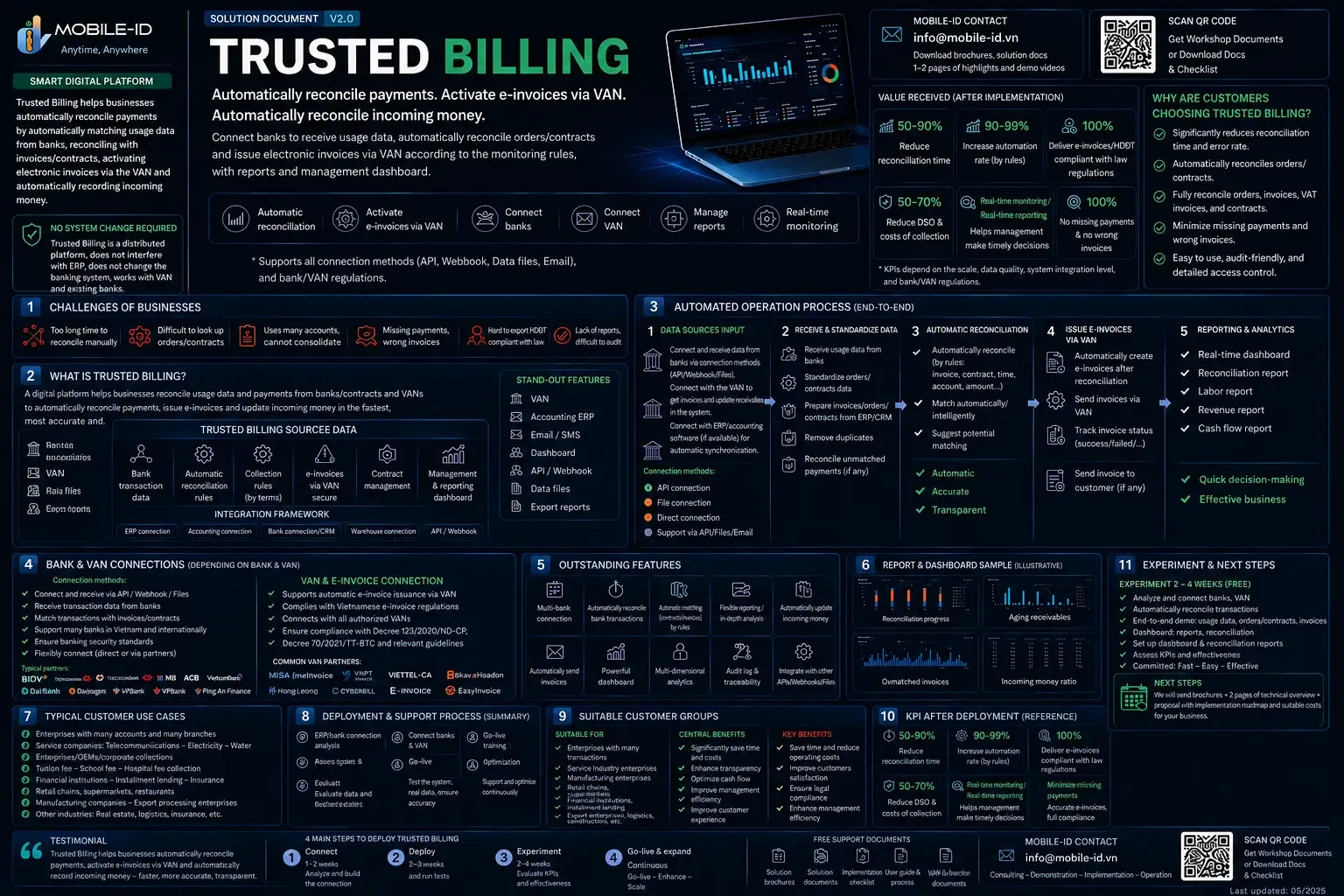
Trusted Billing is the central orchestration layer for payments, receivables and e-invoicing
In many businesses, order, payment, receivable and invoice data sit in different systems. Manual reconciliation increases processing time, makes discrepancies hard to control, and leaves teams relying on spreadsheets or email.
Trusted Billing adds an intermediary orchestration layer that connects existing data sources, events from Trusted Pay or Trusted PalmPay, bank data and e-invoicing providers. The platform applies reconciliation rules and maintains processing status continuously from the moment payment is received through to invoice completion.
Detect Incoming Funds
Ingests payment data from banks or intermediary sources under the agreed connection scope.
Rule-Based Reconciliation
Matches transactions to orders, contracts or receivables based on reference codes and business conditions.
E-Invoicing Orchestration
Sends issuance requests, receives results and syncs status with the e-invoicing provider.
Centralized Governance
Tracks processing status, exceptions, change history and reporting for operations or audits.
One unified flow from business data to e-invoicing
Connect Data Sources
ERP, accounting software, CRM, POS, ECR, banks and e-invoicing providers.
Collect and Normalize
Sync transactions, orders, receivables and payment information into a unified structure.
Automated Reconciliation
Apply rules to identify matched, unmatched or exception-handling transactions.
Orchestrate Invoicing
Send issuance requests, receive status and handle adjustment cases per the workflow.
Reporting and Audit Trail
Consolidate results, track history and support faster decision-making.
Three approaches suited to different business models
Start lean, no need to replace the whole system
Suited to businesses that want to cut reconciliation time and automate invoicing within a clear scope before expanding.
Orchestrating multiple systems, banks and member units
Suited to corporations, multi-branch chains, or businesses with high requirements for access control, audit trails and operational oversight.
Add payment, reconciliation and e-invoicing capability to existing software
ERP, POS, ECR partners and system integrators can connect Trusted Billing to extend their incoming-payment and invoicing workflow without building the entire bank connectivity and e-invoicing layer themselves.
Keep your source systems, add a centralized orchestration layer
Trusted Billing does not require businesses to give up their existing ERP, accounting software, POS or ECR. Instead, the platform connects these systems with payment data and e-invoicing providers to create one consistent processing flow.
Architecture Overview
The connection method and data scope are defined after surveying the business’s existing systems.
| Connection Group | Data Exchanged | Control Method |
|---|---|---|
| Orders and receivables | Order code, customer, contract, amount, due date and reference information. | Completeness checks and duplicate-record limits. |
| Payments | Transaction details, amount, timestamp and payment status. | Source-data validation and cross-checking against agreed rules. |
| Reconciliation | Matched, unmatched, missing, excess or exception-handling results. | Automated rules combined with authorized-reviewer checks. |
| E-invoicing | Requests to issue, adjust, replace or cancel per the business process. | Input-data checks and processing-status sync. |
| Return of results | Payment, reconciliation and invoice status updated back to ERP, POS or ECR. | Automatic retries on connection interruption and alerts when intervention is needed. |
Suited to models that connect the front-end payment experience with back-office operations
Retail and Store Chains
Combine QR via Trusted Pay or palm payment where appropriate; Trusted Billing reconciles transactions and syncs invoice status back to POS.
E-Commerce
Match QR, bank transfer or identity-linked accounts to online orders and automatically move to invoice issuance.
Education and Campuses
Reconcile tuition against students, billing terms and invoices; explore PalmPay for canteens or high-frequency repeat services.
Healthcare
Link payments to service records, reduce reconciliation discrepancies, issue invoices and track status.
Recurring Services
Track fees, payment reminders, receivables and invoice status; loyalty programs can help with customer retention.
Enterprise Transactions
Reconcile payments against contracts, invoices and aging receivables; provide management data across multiple entities or branches.
Ready to scale to enterprise requirements
For large enterprises, the platform’s value lies not just in automation but in the ability to control access, delegate permissions and maintain a continuous processing history.
One unified ecosystem with clearly defined boundaries of responsibility
Businesses can use only Trusted Billing or add other payment touchpoints as needed.
The role of banks, accounts, stored value, wallets or ledgers must be clearly described in the architecture and contract.
Trusted PalmPay requires a consent mechanism, data protection, information lifecycle management and appropriate fallback options.
The document relates to the criteria for Mobile-ID’s e-invoicing solution, not certification of Trusted Pay or Trusted PalmPay’s functionality.
Measuring effectiveness against real operating data
Effectiveness targets are set from current-state figures and re-measured on the same data scope after the pilot phase. This approach lets businesses objectively evaluate automation level, processing time and scalability.
The figures above are reference targets from the Trusted Billing sales deck, not a default commitment. Official targets are defined after a survey and pilot on real data.
Current-State Data
- Number of transactions and invoices per period.
- Average reconciliation time.
- Share of manual vs. automated processing.
- Number of exceptions and their processing time.
- Lag time from payment to invoice.
Post-Pilot Results
- Before-and-after comparison on the same data scope.
- Automation rate and reasons for mismatches.
- Time saved and scalability potential.
- Remaining risks and conditions for full production.
- Proposed architecture and rollout plan.
A real-world pilot over 2–4 weeks with a clear scope and evaluation criteria
Businesses can start with a scope small enough to control yet representative enough to measure effectiveness: one or two banks, one e-invoicing provider, and agreed real transaction data.
What the Business Prepares
- List of banks and accounts in scope.
- The e-invoicing provider currently in use.
- Sample order or receivable data.
- Current reconciliation rules.
- Business and IT points of contact.
What Mobile-ID Delivers
- Reconciliation and data-mapping documentation.
- A reconciliation rule set for the pilot scope.
- A dashboard and results report.
- A list of exceptions and how to handle them.
- A proposed scope for full rollout.
What businesses typically want to know before deploying
Is No. 131 part of Notice 664/TB-CT?
No. No. 131 is the position where Mobile-ID appears on the online consolidated list at the time of cross-checking. Notice No. 664/TB-CT is a separate document source; this article keeps the two sources separate to avoid confusion.
Does Trusted Billing replace an ERP or accounting system?
No. Trusted Billing acts as a connection and orchestration layer between existing systems, banks and e-invoicing providers, within the agreed scope.
Is a business required to switch e-invoicing providers?
Not necessarily. Whether you can keep your current provider depends on the existing connection scope and the technical approach agreed during the survey stage.
Can Trusted Billing connect to multiple banks?
Yes, a multi-bank connection scope can be built out over time. Businesses typically start with one or two representative sources before expanding.
How do ERP, POS or ECR systems receive status back?
Systems can receive results via an application programming interface, automated status callbacks, or data files, depending on the capability of the source system and project design.
How are unmatched transactions handled?
The transaction is placed on an exception list for an authorized reviewer to check, add information to, or approve per the business’s process.
What is the issue date and service website stated in the notice?
Notice No. 664/TB-CT was issued and digitally signed on 07/27/2026; the signing time is 14:57. Mobile-ID’s published service website in the document is https://trustedbilling.mobile-id.vn/.
Is Notice 664/TB-CT a license?
It should not be called a standalone license. It is a document publicly confirming that the organization meets the full criteria under Clause 1, Article 11 of Circular 32/2025/TT-BTC.
How does Trusted Billing combine with Trusted Pay and Trusted PalmPay?
Trusted Pay and Trusted PalmPay can provide the payment touchpoints and events. Trusted Billing ingests the related data to reconcile it against orders or receivables, orchestrate e-invoicing, manage exceptions and sync status back to ERP, POS or ECR. The specific scope depends on the project architecture.
Does a business have to deploy all three platforms at once?
No. A business can start with Trusted Billing to solve invoicing and reconciliation; add Trusted Pay when it needs to standardize QR and point-of-sale payments; or pilot Trusted PalmPay in high-transaction-frequency environments.
Does Notice 664/TB-CT apply to Trusted Pay and Trusted PalmPay?
It should not be interpreted that way. The notice relates to publicly confirming that Mobile-ID meets the criteria for providing e-invoicing solutions. Trusted Pay and Trusted PalmPay are separate Mobile-ID product capabilities.
How long does the pilot phase take?
The suggested window is 2–4 weeks for a controlled scope. Actual timing depends on the readiness of the data, systems and the parties involved in the connection.
Find the right starting point in Mobile-ID’s ecosystem
Mobile-ID will work with your business to identify the priority problem — invoicing, reconciliation, QR, point of sale, loyalty, or palm payments — then propose a pilot scope and expansion roadmap.
Sources, Verification and Content Scope
The legal content is based on Notice No. 664/TB-CT dated 07/27/2026 and its attached digitally signed PDF. Position 131 is presented as a separate cross-check result on the online consolidated list at the time of this update, and is not content from Notice 664/TB-CT itself. The description of Trusted Billing, Trusted Pay, Trusted PalmPay, architecture and business benefits is compiled from the sales deck and Mobile-ID’s official product websites.


Community Discussion